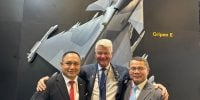
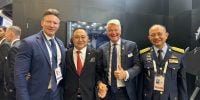
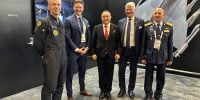
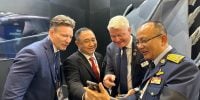
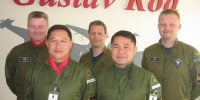
On 3 February 2026, Air Chief Marshal Manat Chavanaprayoon, Director General of the Civil Aviation Authority of Thailand (CAAT), visited the exhibition booth of Saab during the Singapore Airshow 2026 at the Changi Exhibition Centre, Republic of Singapore.
During the visit, the CAAT delegation received briefings on Saab’s key technologies and innovations, including advanced training and simulation solutions, counter-unmanned aerial systems (Counter-UAS), the Gripen E multi-role fighter aircraft, sensor and electronic warfare systems, as well as total airport management and air traffic management solutions. These developments reflect the growing trend of integrating civil aviation technologies with aviation security and defence capabilities to enhance safety, operational efficiency, and system resilience in future airspace environments.
The visit also included discussions with Air Chief Marshal Wachirapon Muangnoi, Assistant Commander-in-Chief of the Royal Thai Air Force, on advancing civil-military integration — a significant global trend in aviation. Thailand has been recognised as a strong example of effective collaboration between civil and military stakeholders in airspace management, aviation safety enhancement, and supporting the sustainable growth of regional air traffic.
The engagement further highlighted the longstanding aviation technology partnership between Thailand and Sweden. In 2004, Air Chief Marshal Manat Chavanaprayoon and Air Chief Marshal Phanphakdee Pattanakul, former Commander-in-Chief of the Royal Thai Air Force, were the first Thai pilots to participate in the flight evaluation of Gripen in Sweden, prior to Thailand’s acquisition of the aircraft in 2007. This milestone reflects the strategic cooperation between the two countries in aviation technology development. During the meeting, Mr. Robert Bjorklund, a senior executive at Saab and former Gripen squadron commander of the Swedish Air Force, warmly welcomed the delegation.
The visit underscores CAAT’s role as a civil aviation regulator actively monitoring emerging technologies and evolving security challenges, particularly the increasing convergence between civil aviation and aviation security and defence ecosystems. Such integration is becoming increasingly important in areas including airspace management, counter-UAS strategies, and the development of aviation infrastructure that requires close coordination between civil and military sectors to strengthen safety, security, and regional confidence in the aviation system.