

INITIAL APPROVAL OF CAMO CERTIFICATE
Last updated: 12-Oct-2026
Who should apply for a CAMO certificate?
How much does the CAMO certification cost?
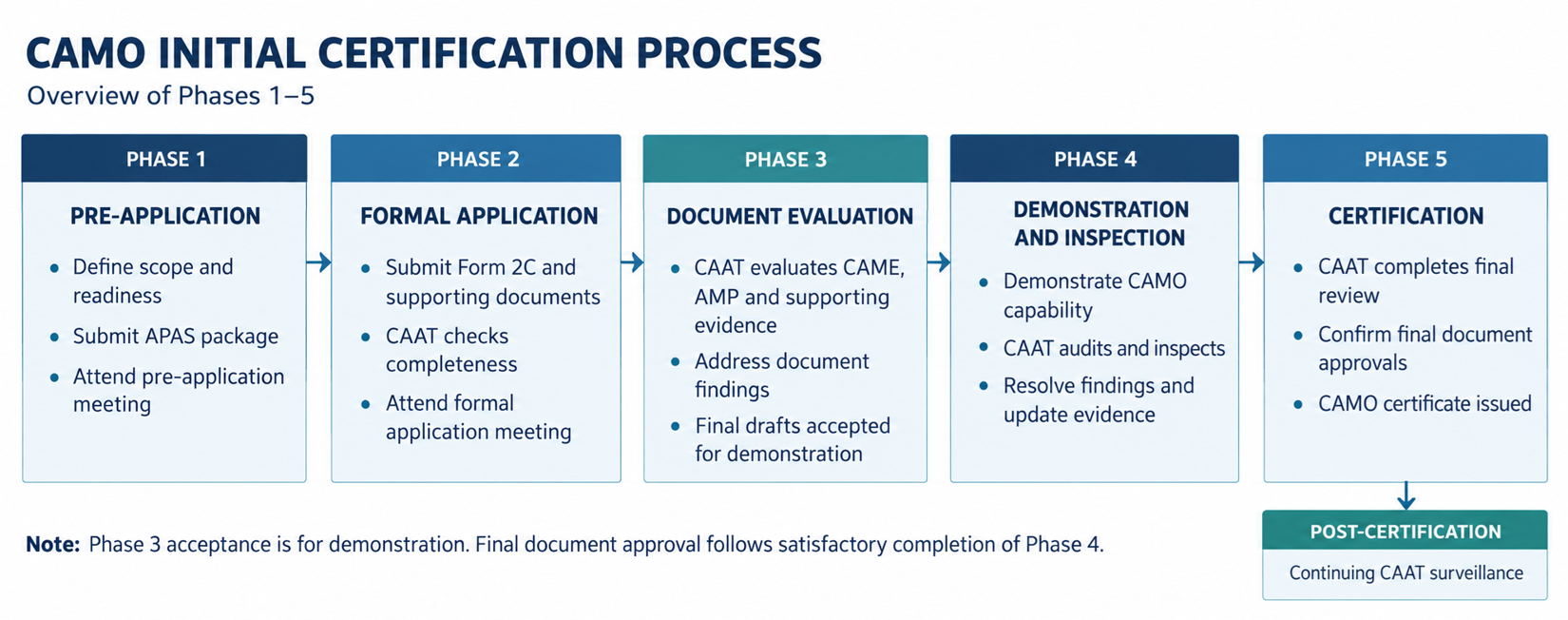
The CAMO initial certification process consists of 5 phases designed to ensure that the applicant is fully prepared and capable of managing continuing airworthiness in accordance with TCAR AIR Part-CAMO. These phases cover the complete certification cycle, starting from pre-application discussion, followed by formal application submission, document evaluation, demonstration and inspection, and final certification. Each phase is intended to progressively verify the applicant’s procedures, personnel, resources, management system, aircraft maintenance programme control, and readiness to exercise the requested CAMO privileges.
Applicants seeking an AOC may apply the CAMO certification process in parallel with the AOC certification process. Nevertheless, before the aircraft is used for actual demonstration flights under AOC Phase 4.2, the aircraft must already be managed by an approved CAMO holding the applicable aircraft rating. The aircraft should therefore be accepted into the CAMO system, the applicable AMP should be in place, and the continuing airworthiness status of the aircraft should be properly controlled by the approved CAMO before any actual flight operation is conducted.
PHASE 1: PRE-APPLICATION
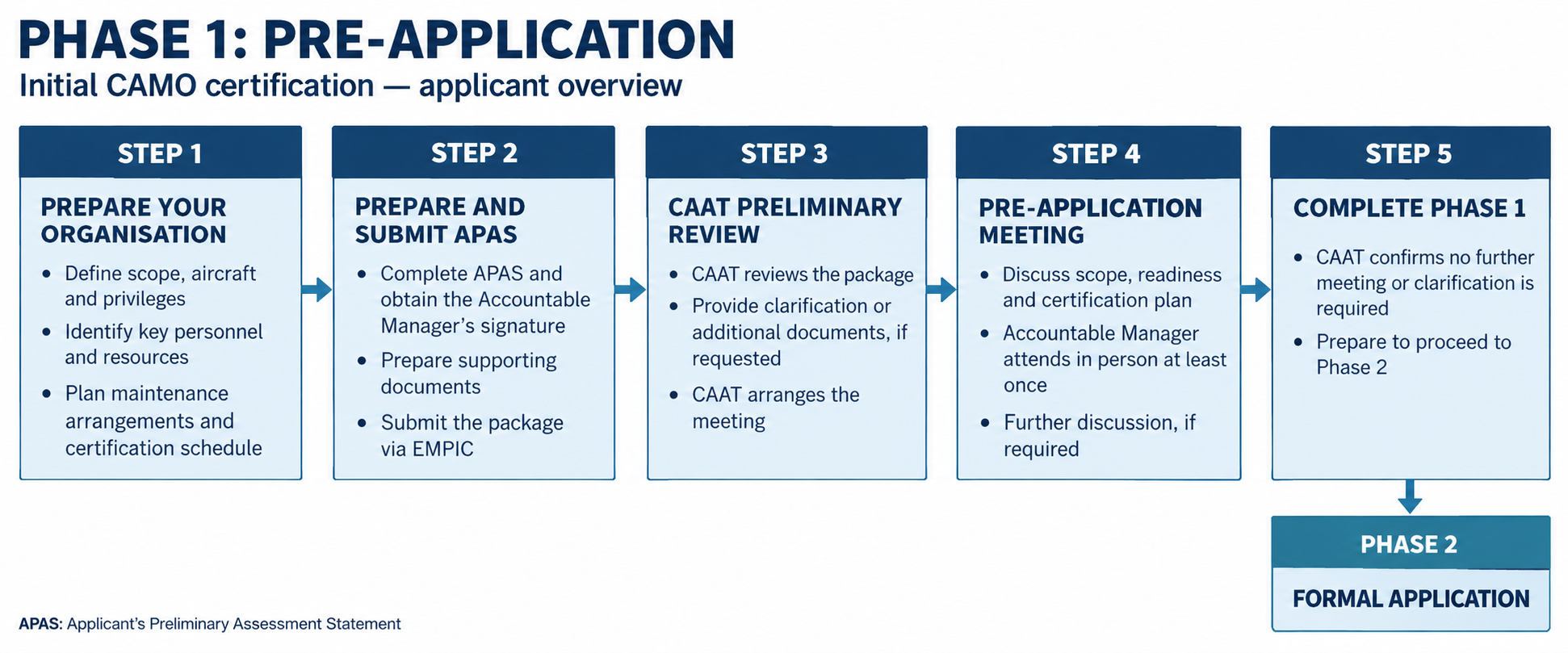
1. Understand Your Intended CAMO Approval and Prepare Your Organisation
Before starting the CAMO certification process, the applicant should first understand its intended CAMO approval needs and prepare its organisation accordingly. This includes considering the proposed scope of approval, aircraft to be managed, intended privileges, organisation structure, key personnel, facilities, resources, technical data, subcontracted continuing airworthiness management tasks, maintenance arrangements, and expected certification timeline.
This preparation will help the applicant complete the Applicant’s Preliminary Assessment Statement (APAS) and support an effective pre-application discussion with CAAT before submitting the formal CAMO application.
The applicant should prepare the following information before completing the APAS:
A. Applicant and company information
- official registered company name;
- mailing address;
- business or trade name, if different from the official company name;
- principal place of business (PPB);
- billing or invoice address, if different;
- base of operations or location where CAMO management activities will be performed;
- expected date to start business, operations, or services;
- AOC three-letter designator, where applicable.
B. Management personnel and contact persons
The applicant should identify the proposed management personnel and key staff required for the intended CAMO approval, including the main contact person responsible for the application. This should include names, positions, telephone numbers, email addresses, and other relevant contact details.
The applicant should also consider whether the proposed personnel structure is sufficient for the intended CAMO scope, including continuing airworthiness management, airworthiness review, compliance monitoring, safety management, maintenance programme control, technical records, maintenance planning, and contracted maintenance oversight, as applicable.
C. Intended approval type and privileges
The applicant should clearly determine the type of organisation approval and privileges being sought before completing the APAS. For a CAMO applicant, this should include the intended continuing airworthiness management and airworthiness review privileges.
The applicant should consider whether the proposed CAMO approval will cover:
- Part-M aircraft;
- Part-ML aircraft, if applicable;
- own aircraft fleet;
- third-party aircraft;
- AOC aircraft;
- airworthiness review privileges;
- any specific aircraft ratings or aircraft types intended to be included in the CAMO approval.
D. Aircraft to be managed
The applicant should prepare information on the aircraft intended to be managed by the CAMO, including:
- aircraft make and type;
- model, group, or series;
- engine model;
- intended aircraft operation;
- whether the aircraft will be part of an AOC operation;
- whether the aircraft will be imported, phased-in, or added to an existing fleet;
- whether the AMP will be aircraft-specific, generic, baseline, or subject to bridging or phase-in assessment.
Where the aircraft registration or specific aircraft MSN is not yet available, the applicant should provide the best available information on the intended aircraft type, model, engine, and expected scope.
Do we need to acquire an aircraft before being approved as CAMO?
E. Subcontracted CAMO Activities and External Support
The applicant should identify any organisation or service provider intended to perform activities under the applicant’s CAMO management system. These activities include support functions used by the CAMO to demonstrate compliance with TCAR AIR Part-CAMO.
This may include, as applicable:
- subcontracted continuing airworthiness management activities;
- technical records support;
- maintenance planning support;
- reliability programme support;
- AMP development or AMP review support;
- AD, SB, modification, or repair assessment support;
- continuing airworthiness data analysis;
- software, IT system, or electronic records system support;
- compliance monitoring support;
- safety management support;
- training providers;
- other external technical or administrative support used for CAMO functions.
For each subcontracted activity or external support provider, the applicant should prepare the organisation name, address, scope of service, responsible person, proposed interface with the CAMO, and the method by which the CAMO will control, monitor, and accept the work performed.
The applicant should understand that subcontracting a CAMO activity does not transfer the regulatory responsibility from the CAMO to the subcontracted organisation. The CAMO remains responsible for ensuring that all subcontracted activities are properly controlled, monitored, and integrated into its management system.
F. Maintenance Arrangements
The applicant should separately identify the approved maintenance organisations intended to perform maintenance on the aircraft managed by the CAMO, including its engines, components, and equipment.
This may include, as applicable:
- line maintenance organisation;
- base maintenance organisation;
- major component maintenance organisation (e.g. engine, propeller, APU, landing gear);
- other component maintenance organisation (e.g. wheels and brakes, battery, avionics);
- specialised maintenance provider (e.g. NDT, borescope, aircraft painting);
- owned or internal Part-145 / AMO capability, where applicable.
For each maintenance organisation, the applicant should prepare the organisation name, address, approval number, approval scope, type of maintenance to be performed, aircraft or component applicability, maintenance location, contract or internal arrangement status, and the intended interface between the CAMO and the maintenance organisation.
Before completing the APAS, the applicant should consider whether suitable approved maintenance organisations are available for the aircraft type, engine type, component type, and maintenance scope intended to be managed by the CAMO. This is particularly important where the applicant does not hold its own Part-145 / AMO approval. Lack of suitable maintenance organisations may delay the CAMO certification process or prevent the applicant from demonstrating adequate maintenance arrangements for the aircraft intended to be managed.
The applicant should also consider how engines, APUs, landing gears, major components, rotable components, and other parts will be supported. This may include repair by an approved maintenance organisation, pool part arrangements, exchange units, leased components, or replacement parts purchased from suppliers. Where the applicant intends to rely on pool, exchange, lease, or purchase-and-replace arrangements, the applicant should ensure that the arrangement allows the CAMO to maintain sufficient visibility over component eligibility, traceability, release documentation, life-limited parts status, AD/MCAI status, modification or repair status, configuration applicability, and records transfer.
Where the maintenance organisation will be used only on a one-time or infrequent basis, such as for an engine shop visit, landing gear overhaul, or specific component repair, the applicant should identify how the organisation will be assessed before use and how maintenance release documents, work reports, component status, life-limited parts status, modification or repair status, and records return will be controlled.
Although supplier control and incoming inspection may normally be performed by the AMO when parts are procured or received by the AMO, the CAMO should ensure that the overall arrangement remains compatible with its continuing airworthiness responsibilities for the aircraft managed.
There is no AMO for the aircraft type to be managed; what should we do?
G. Existing CAAT approvals or certificates
The applicant should identify any existing CAAT approvals or certificates already held, such as:
- AOC;
- Part-145;
- CAO;
- ATO;
- other CAAT approvals or certificates.
The approval number should be provided where available.
H. Accountable Manager confirmation
Before completing the APAS, the applicant should identify the person intended to be appointed as the Accountable Manager for the proposed CAMO approval. The Accountable Manager should have sufficient corporate authority to ensure that the CAMO can be properly financed, resourced, and implemented.
For an applicant that is, or intends to become, an AOC holder, the CAMO Accountable Manager shall be the same person appointed as the Accountable Manager for the AOC holder. The applicant should therefore consider this requirement early when planning its CAMO approval, AOC certification, organisation structure, aircraft to be managed, maintenance arrangements, resources, and certification timeline.
The Accountable Manager should understand the applicant’s business model and planned operations to ensure that the proposed CAMO approval is realistic and aligned with the aircraft and operations to be supported.
2. Submit the APAS and Pre-Application Package
An applicant willing to apply for an CAAT CAMO shall submit to CAAT the Applicant’s Preliminary Assessment Statement (APAS) form together with relevant preliminary supporting documents. The APAS and preEapplication package are used to provide CAAT with preliminary information on the applicant’s intended CAMO approval, proposed scope, aircraft to be managed, organisation readiness, key personnel, resources, subcontracted tasks, maintenance arrangements, and certification plan. After receiving the APAS, CAAT will conduct a preliminary review of the submitted information. CAAT may request clarification, additional information, or supporting documents before arranging the pre-application meeting.
A. Fill in the APAS
(1) Get the APAS form. This form establishes the intent of the applicant to continue with the process of certification.
(2) Fill in the organisation information according to the ‘Instructions for Completing the APAS’ section of the form.
(3) Ensure all information is fulfilled, and the APAS is signed by the appointed Accountable Manager in Section 1D. The signature of the Accountable Manager denotes the intent to seek CAAT certification as a CAMO.
B. Prepare supporting documents
Ensure the following documents are prepared for the pre-application package submission:
(1) The completed and signed APAS form;
(2) Company intention letter to CAAT’s Director General that includes draft nominating all key management personnel;
(3) Copy of commercial company registration certificate demonstrating as a Thai juristic person;
(4) Accountable Manager empowerment letter, signed by the authorised signatory of the company, formally appointing the nominated person as the Accountable Manager and confirming that the person is vested with the authority to act on behalf of the company and to ensure that the necessary resources and funds are available for all continuing airworthiness management activities in accordance with § CAMO.A.305(a).
C. Submit the Pre-Application package via EMPIC
Submit the APAS and all supporting documents via

CAAT will use the submitted information to conduct a preliminary review and to determine whether the applicant is ready to proceed to the Pre-Application Meeting.
3. Attend the Pre-Application Meeting with CAAT
A. Prepare your information
Before attending the Pre-Application Meeting, the applicant should prepare sufficient information to explain its intended CAMO approval and organisation readiness to CAAT. The applicant should be ready to discuss, as applicable:
(1) the organisation of the company, PPB, facilities, and location where CAMO activities will be performed;
(2) the intended CAMO management structure and, where applicable, its interface with the AOC management structure;
(3) the proposed Accountable Manager, nominated personnel, key personnel, and available manpower;
(4) how the CAMO will be financed and resourced to support the intended continuing airworthiness management activities;
(5) the intended CAMO scope of work, aircraft ratings, privileges, and any limitations expected;
(6) the aircraft intended to be managed, including aircraft type, number of aircraft, intended operation, operating area, and expected aircraft delivery or import plan;
(7) the plan for continuing airworthiness management contract with operator/owner, as applicable
(8) whether the aircraft will be the first aircraft under the requested rating, or whether the rating will be supported by a generic or baseline AMP;
(9) the plan for aircraft delivery, registration, Certificate of Airworthiness, AMP approval, airworthiness review, and aircraft entry into the CAMO system;
(10) the intended maintenance arrangements, including whether maintenance will be performed by the applicant’s own AMO approval or by contracted approved maintenance organisations;
(11) the intended arrangements for line maintenance, base maintenance, engine/APU/landing gear maintenance, component maintenance, specialised maintenance, and one-time or infrequent maintenance providers;
(12) any intended subcontracted continuing airworthiness management tasks;
(13) the plan for aircraft maintenance programme development, control, and approval;
(14) the plan for aircraft records, maintenance planning, AD control, defect control, modification and repair status, component status, and continuing airworthiness data management;
(15) the airworthiness review privilege and proposed ARS, including plan for physical survey or AR demonstration using an actual aircraft;
(16) the plan for CAMO certification and expected communication channel with CAAT
The applicant should ensure that the persons attending the meeting are sufficiently familiar with the proposed CAMO business model, planned operations, aircraft to be managed, resources, maintenance arrangements, and certification timeline. This will help CAAT and the applicant establish a common understanding before proceeding to the formal application phase.
B. Meeting with the CAAT
After the APAS and Pre-Application Package have passed CAAT’s preliminary review, CAAT will contact the applicant via email to arrange and invite the applicant to attend a Pre-Application Meeting. The meeting will normally be held at CAAT Headquarters in Bangkok.
The proposed Accountable Manager should attend the meeting in person at least once during Phase 1. The purpose of the meeting is to ensure that the proposed Accountable Manager and the applicant organisation have a common understanding with CAAT on the CAMO certification process, the applicable regulations and requirements, CAAT’s expectations, and the information to be prepared for Phase 2 – Formal Application Package.
The meeting will also provide an opportunity for CAAT and the applicant to discuss the proposed CAMO approval scope, intended aircraft to be managed, organisation readiness, key personnel, resources, maintenance arrangements, subcontracted continuing airworthiness management tasks, and certification timeline.
The applicant should study the applicable requirements and available guidance material before attending the meeting. The meeting should be used as an opportunity for the applicant to ask questions, clarify uncertainties, and ensure that its understanding is aligned with CAAT before proceeding further in the certification process.
Where certain information remains unclear, the applicant may request an additional meeting with CAAT. CAAT may also arrange further discussion where it considers that the applicant has not yet demonstrated sufficient understanding of the certification process, applicable requirements, expected submissions, or readiness needed to proceed to the formal application phase.
4. Complete Phase 1 and Proceed to Phase 2 – Formal Application
Once CAAT considers that no further pre-application meeting or clarification is required, Phase 1 may be concluded. The applicant may then proceed to Phase 2 – Formal Application, which includes fee payment and submission of the formal application package.
After the applicable fee payment has been processed, CAAT will send an email to the applicant requesting submission of the formal application package. The applicant should then submit the required documents in accordance with the instructions provided by CAAT.
PHASE 2: FORMAL APPLICATION
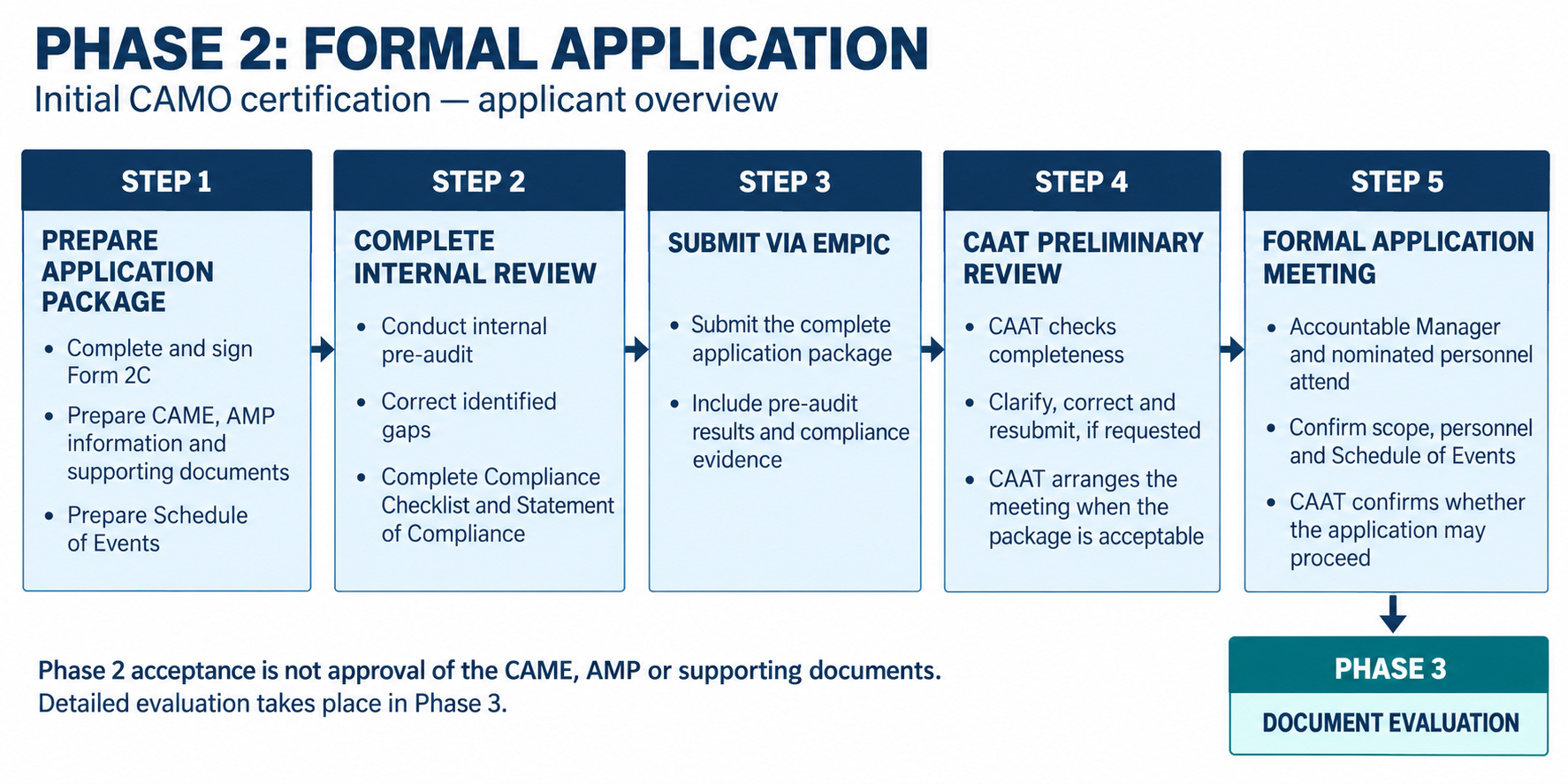
During this phase, the applicant formally submits its application for CAMO approval to CAAT. The formal application package should reflect the intended CAMO approval scope, aircraft ratings, privileges, aircraft to be managed, management personnel, facilities, resources, subcontracted continuing airworthiness management tasks, maintenance arrangements, and certification schedule.
The formal application should be submitted in accordance with the instructions provided by CAAT after completion of Phase 1. The application package should be complete, properly signed, and supported by all applicable attachments, manuals, checklists, and evidence required for CAAT to begin the detailed assessment.
As part of the formal application package, the applicant should provide a statement that the submitted expositions, procedures, checklists, and supporting documents have been internally reviewed and found to comply with the applicable TCAR AIR Part-CAMO requirements. The applicant should also submit the applicable compliance checklist, including the means by which compliance is demonstrated.
1. Prepare formal application package
The applicant should prepare a complete formal application package to support CAAT’s detailed evaluation. The package should be consistent with the requested CAMO approval scope, aircraft ratings, privileges, organisation structure, personnel nomination, facilities, maintenance arrangements, and aircraft to be managed.
The formal application package should include, as applicable:
A. Formal application form, company letter, and Accountable Manager empowerment
The applicant should submit the completed and signed formal CAMO application form (CAAT Form 2C) together with a company transmittal letter addressed to CAAT.
(1) The application form should clearly reflect the requested CAMO approval scope, aircraft ratings, intended privileges, facilities, and key management personnel. The form should be completed in accordance with CAAT’s instructions and signed by the proposed Accountable Manager.
How to complete CAAT Form 2C for CAMO Application?
(2) The company letter should confirm the applicant’s intention to apply for CAMO approval and should identify the requested approval scope, aircraft ratings, intended privileges, and clear nominated key management personnel in accordance with § CAMO.A.305.
(3) The applicant should also provide an Accountable Manager empowerment letter, signed by the authorised signatory of the company, formally appointing the nominated person as the Accountable Manager and confirming that the person has the authority to act on behalf of the company and to ensure that the necessary resources and funds are available for continuing airworthiness management activities.
The information stated in the application form, company letter, Accountable Manager empowerment letter, and CAME should be consistent.
B. Company registration and legal information
The applicant should provide evidence demonstrating that the applicant is a Thai juristic person in accordance with the applicable CAAT requirements.
The supporting documents should include, as applicable:
- official company registration certificate, juristic person certificate, company affidavit, certificate of incorporation, or equivalent official document;
- evidence of registered company name and registered address;
- information identifying the authorised signatory of the company;
- shareholder list or shareholder register showing the names of shareholders, nationality, number of shares, and percentage of shareholding;
- Power of Attorney or authorisation document, where the application or related documents are signed by a person acting under delegated authority.
The company name, registered address, authorised signatory, and shareholding information should be clear, current, and consistent with the information provided in the application form, company letter, CAME, and other submitted documents.
Where any supporting document is issued in Thai, an English translation may be requested where necessary to support CAAT’s evaluation.
C. Financial, economic, and legal readiness
The applicant should provide financial, economic, and legal information to demonstrate that the organisation is able to support the requested CAMO approval and comply with § CAMO.A.305(a).
The submitted information should show that the organisation has adequate financial resources and legal capability to establish, maintain, and continuously support the intended continuing airworthiness management activities, including personnel, facilities, technical data, tools or systems, contracted services, maintenance arrangements, subcontracted continuing airworthiness management tasks, and other resources necessary for the proposed scope of approval.
The supporting documents may include, as applicable:
- financial status report or saving statement issued by a bank;
- budget allocation or annual financial plan showing a dedicated line item for continuing airworthiness management activities;
- other financial, economic, or legal information necessary to demonstrate that sufficient resources and funds are available for the proposed CAMO activities.
The financial evidence provided should be commensurate with the scale and complexity of the intended CAMO activities, including the proposed scope of approval, aircraft ratings, fleet size, aircraft complexity, number of aircraft to be managed, intended privileges, personnel, facilities, contracted services, maintenance arrangements, subcontracted continuing airworthiness management tasks, and expected start of operations.
D. Business Operation Plan, Intended CAMO Activities, and Schedule of Events
The applicant should submit a Business Operation Plan, including the intended CAMO activities, together with the completed Schedule of Events.
The purpose of this information is to allow CAAT to understand the applicant’s intended CAMO business model, proposed scope of approval, aircraft to be managed, continuing airworthiness management and maintenance arrangements, and the planned timeline for achieving CAMO certification.
(1) Business Operation Plan and Intended CAMO Activities
The applicant should prepare a Business Operation Plan describing how the applicant intends to operate as a CAMO and what continuing airworthiness management activities will be performed under the requested approval.
The Business Operation Plan should describe, as applicable:
a. Intended CAMO business model
The applicant should describe the intended CAMO business model, including whether the CAMO will:
- manage aircraft operated under its own AOC;
- manage aircraft owned or operated by another person or organisation;
- provide CAMO services to third-party aircraft owners or operators;
- manage leased aircraft;
- manage aircraft under commercial, non-commercial, or private operation
b. Requested scope of approval
The applicant should identify the requested CAMO approval scope, including:
- aircraft ratings requested;
- aircraft type, model, series, and engine type;
- intended privileges, such as airworthiness review privilege, where applicable;
- any limitation or specific condition expected under the requested approval
c. Aircraft to be managed
The applicant should describe the aircraft intended to be managed, where known, including:
- aircraft registration, MSN, type, model, and engine configuration;
- number of aircraft to be managed;
- aircraft owner or operator;
- intended operation;
- expected aircraft delivery, import, or phase-in plan, where applicable.
Where no specific aircraft has yet been identified, the applicant should explain how the requested rating or scope will be supported, such as by using a generic or baseline AMP, where accepted by CAAT.
d. Responsibility arrangement and contract model
The applicant should describe how continuing airworthiness responsibility will be assigned and controlled, including, where applicable:
- management of aircraft under the applicant’s own AOC or aircraft;
- leased aircraft arrangement;
- continuing airworthiness management contract with another aircraft owner or operator;
- draft or template CAM contract where no customer has yet been identified;
- interface between the aircraft owner/operator and the CAMO
e. Maintenance and subcontracted arrangements
The applicant should describe the intended maintenance support and any subcontracted continuing airworthiness management tasks, including:
- line maintenance;
- base maintenance;
- engine, APU, landing gear, and component maintenance;
- specialised maintenance providers;
- own AMO or contracted AMO arrangements;
- subcontracted CAM tasks, where applicable
f. Resources and readiness
The applicant should describe the resources planned to support the intended CAMO activities, including:
- key personnel and manpower;
- facilities;
- technical data;
- planning or records system;
- tools, software, or IT system;
- expected start date of CAMO activities
(2) Schedule of Events
The applicant should submit a completed Schedule of Events form showing the planned timeline for the CAMO certification process.
The Schedule of Events is intended to provide CAAT with a clear and structured plan of the applicant’s proposed certification activities. It is used to show how the applicant plans to complete the key milestones required for CAMO certification, including document submission, document evaluation, finding correction, personnel readiness, training, internal pre-audit, maintenance arrangement readiness, demonstration and inspection, aircraft entry or import readiness where applicable, and final certification.
The proposed schedule should be realistic, achievable, and commensurate with the applicant’s actual readiness, resources, organisation size, fleet size, aircraft complexity, intended privileges, maintenance arrangements, subcontracted tasks, and planned start of CAMO activities.
When preparing the Schedule of Events, the applicant should ensure that sufficient time is allocated for:
- preparation and submission of the formal application package;
Note: Although the Schedule of Events is submitted as part of the formal application package, the applicant should plan and complete the preparation of all required documents, internal reviews, signatures, and supporting evidence before the formal submission. The date entered for this activity should represent the applicant’s planned readiness and submission date for the complete formal application package.
- CAAT document evaluation during Phase 3;
- correction of findings raised during document evaluation;
- training of personnel on accepted procedures;
- internal pre-audit and correction of internal gaps;
- readiness of facilities, personnel, records, systems, and maintenance arrangements;
- demonstration and inspection activities during Phase 4;
- correction of findings raised during demonstration and inspection;
- reassessment by CAAT, where significant findings are raised;
- final certification activities during Phase 5
Where an aircraft is expected to be imported, delivered, or entered into the CAMO system during the certification process, the applicant should also ensure that the Schedule of Events properly reflects the aircraft entry or import plan for demonstration at the end of Phase 4. This should include, as applicable, aircraft delivery, records availability, AMP or bridging readiness, maintenance arrangement readiness, aircraft entry or import readiness demonstration, airworthiness review staff performance assessment, and submission of the final aircraft entry or phase-in package.
How to import aircraft for CAMO Certification?
The Schedule of Events should not be prepared as an optimistic target date only. It should represent a workable certification plan that allows adequate time for CAAT review, applicant response, finding correction, implementation of accepted procedures, and verification of readiness before proceeding to the next phase.
If the plan changes after submission, the applicant should update the Schedule of Events and promptly inform CAAT of any change, delay, or deviation that may affect the certification timeline.
E. Continuing Airworthiness Management Arrangement with the Aircraft Operator/Owner, where applicable
The applicant should provide evidence showing how continuing airworthiness responsibility for the aircraft to be managed will be assigned, controlled, and discharged.
(1) AOC holder managing aircraft operated under its own AOC
Where the applicant is an AOC holder applying for CAMO approval to manage aircraft operated under its own AOC:
- a continuing airworthiness management contract in accordance with Appendix I to Part-M is not required, where the CAMO is part of the same AOC holder;
- the applicant should demonstrate the integration between the AOC holder and the CAMO through the CAME, aircraft list, AMP control, maintenance arrangements, records system, personnel responsibilities, and other applicable procedures.
(2) AOC holder managing leased aircraft
Where the aircraft is leased, the applicant should provide the relevant lease agreement or responsibility arrangement showing that:
- the continuing airworthiness responsibility is properly assigned to the operator or lessee;
- the CAMO has sufficient authority to manage the continuing airworthiness of the aircraft;
- the CAMO has access to aircraft records, technical data, maintenance data, and maintenance status information;
- the lease or responsibility arrangement does not prevent the CAMO from discharging its continuing airworthiness management responsibilities.
(3) CAMO managing aircraft for another owner or operator
Where the applicant intends to manage aircraft for another aircraft owner or operator, and a continuing airworthiness management contract is required under Part-M, the applicant should provide an actual, draft, or template contract established in accordance with Appendix I to Part-M, as applicable.
The contract should address, as applicable:
- aircraft covered or intended to be covered;
- scope of continuing airworthiness management tasks;
- responsibilities of the aircraft owner or operator;
- responsibilities and authority of the CAMO;
- access to aircraft records and technical data;
- AMP control and amendment process;
- maintenance planning;
- AD/MCAI control;
- defect and occurrence reporting;
- maintenance arrangement interface;
- airworthiness review arrangement;
- records transfer;
- termination or aircraft transfer-out arrangement
(4) Where no customer or aircraft has yet been identified
Where no aircraft owner/operator or specific aircraft has yet been identified, the applicant should still provide a draft or template CAM contract where the requested scope includes management of aircraft for another owner or operator.
The purpose is to demonstrate that the applicant understands the required contractual responsibilities, authority, interfaces, records access, maintenance programme control, continuing airworthiness records, and termination arrangements.
Where no specific aircraft is available to support the certification demonstration, the applicant may also need to support the requested aircraft rating or scope of approval by using a generic or baseline AMP, as accepted by CAAT.
(5) Limitation where contract-control process has not been demonstrated
Where the applicant has not demonstrated the process for managing aircraft under a continuing airworthiness management contract with another owner or operator, CAAT may limit the scope of approval or require prior approval before the CAMO accepts such aircraft under its management.
This means that holding an aircraft rating does not automatically mean that the CAMO has demonstrated the capability to manage aircraft for external owners or operators under a CAM contract.
F. CAME and associated documents
The applicant should submit the Continuing Airworthiness Management Exposition (CAME) and all associated documents required to support the requested CAMO approval.
The CAME should describe the applicant’s organisation, scope of work, management personnel, facilities, continuing airworthiness management procedures, compliance monitoring system, safety management system, contracted maintenance control, subcontracted continuing airworthiness management tasks, airworthiness review process, and privileges requested.
Where separate procedures or manuals are used, such as technical procedures manual, reliability programme manual, compliance monitoring manual, safety management manual, or controlled lists, these documents should be clearly identified and controlled as associated documents to the CAME.
The applicant should use the Compliance Checklist and Guidance Material for Development of CAME as a working tool when developing and reviewing the CAME and associated documents. The checklist should be used to identify each applicable requirement, define the intended means of compliance, and verify that the relevant CAME chapter, associated procedure, form, record, contract, or supporting evidence has been properly established before submission to CAAT.
The CAME and associated documents should be internally reviewed before submission and should be consistent with the application form, organisation structure, personnel nomination, aircraft rating, maintenance arrangements, subcontracted tasks, intended privileges, and other submitted documents.
G. Aircraft Maintenance Programme information
The applicant should submit the applicable Aircraft Maintenance Programme information for each aircraft rating or aircraft type requested.
For aircraft subject to Part-M, the applicant should submit the draft AMP to be approved by CAAT. The AMP should be supported by relevant master or reference data, such as MPD, MRB report, AMM, ICA, ALS, CMR, CDCCL, and other applicable source documents. The applicant should use the Compliance Checklist and Guidance Material for Development of Part-M AMP as a working tool when developing and reviewing the AMP.
For aircraft subject to Part-ML, where the applicant intends to manage Part-ML aircraft and requests the privilege to approve the ML-AMP, the applicant should submit the applicable draft ML-AMP form and supporting information to demonstrate its ability to develop, assess, and approve such AMP.
Part-ML AMP does not require CAAT approvals. It must be approved by CAMO with approved privileges who manage the Part-ML aircraft. If the CAMO is to manage Part-ML aircraft, it shall seek privilege to approve the Part-ML AMP at the same time. As the initial certification, a draft Part-ML AMP is acceptable, and the CAMO shall demonstrate the ability to approve the Part-ML AMP i.a.w. accepted procedures in the CAME during Phase 4. Once the privilege is obtained in Phase 5, the Part-ML AMP shall be considered ‘approved’ by the CAMO i.a.w. the approved privilege.
Where a generic or baseline AMP is submitted, the applicant should clearly identify its assumptions, limitations, applicability, source data, and how it will be converted into an aircraft-specific AMP before the aircraft is managed under the CAMO system.
H. Subcontracted continuing airworthiness management tasks
Where the applicant intends to subcontract any continuing airworthiness management task, the applicant should provide the applicable subcontract agreement, draft subcontract agreement, preliminary arrangement, or other supporting information.
The applicant should also identify the relevant CAME chapters or associated documents describing how the subcontracted task will be assigned, performed, reviewed, accepted, monitored, and controlled under the CAMO management system.
Subcontracting of continuing airworthiness management tasks does not transfer the regulatory responsibility from the CAMO to the subcontracted organisation. The CAMO remains responsible for ensuring that the subcontracted tasks are properly performed, reviewed, accepted, monitored, and controlled under the CAMO management system.
The applicant should demonstrate that the subcontracted organisation will perform the subcontracted tasks as an integral part of the CAMO system. This means that the subcontracted organisation should work in accordance with the applicable CAMO procedures, unless the use of the subcontracted organisation’s own procedures has been accepted by CAAT.
The submitted information should address the following, as applicable:
(1) Subcontracted organisation information
The applicant should identify:
- name and address of the subcontracted organisation;
- facility or location where the subcontracted task will be performed;
- relevant approval, capability, experience, or competence, where applicable;
- responsible contact persons.
This information should be consistent with the information described in the CAME, including:
- CAME 0.2.5 – Facilities, where the subcontracted organisation’s facility or location is relevant to the subcontracted activity;
- CAME 5.3 – List of subcontractors.
(2) Scope of subcontracted tasks
The applicant should clearly identify the continuing airworthiness management tasks intended to be subcontracted, including the aircraft type, rating, fleet, activity, limitation, or exclusion applicable to the subcontracted scope.
The scope of subcontracted tasks should be summarised in CAME 5.3 and linked to the relevant CAME procedures, depending on the nature of the task. For example:
- AD analysis and planning → CAME 1.4
- service bulletin analysis → CAME 1.6
- planning of maintenance → CAME 1.2.6
- reliability monitoring, engine health monitoring → CAME 1.10
- maintenance programme development and amendments → CAME 1.2
The CAME should make clear which tasks are performed by the CAMO itself and which tasks are subcontracted.
(3) CAMO control and responsibility
The applicant should describe in the relevant CAME chapter how the CAMO will retain control over the subcontracted task, including:
- CAMO person responsible for controlling the subcontracted activity;
- method for assigning work to the subcontracted organisation;
- method for reviewing and accepting the output produced by the subcontracted organisation;
- decision points that remain under CAMO authority;
- escalation process where the subcontracted organisation identifies discrepancies, missing data, or compliance issues;
- confirmation that final responsibility remains with the CAMO.
(4) Procedures and working method
The applicant should explain whether the subcontracted organisation will work directly in accordance with the CAMO procedures or whether its own procedures will be used.
Where the subcontracted organisation uses its own procedures, the applicant should describe how those procedures are reviewed, accepted, controlled, and kept consistent with the CAMO management system.
The relevant CAME chapter should describe, as applicable:
- applicable CAMO procedure to be followed;
- interface between the CAMO and subcontracted organisation;
- communication method;
- data transfer method;
- reporting process;
- records to be produced;
- review and acceptance process by the CAMO.
(5) Access to data and records
The applicant should describe how the subcontracted organisation will be provided with the data necessary to perform the subcontracted task, and how the CAMO will control the records produced.
This may include access to:
- aircraft records;
- maintenance data;
- AMP;
- AD/MCAI information;
- modification and repair data;
- component status;
- life-limited parts status;
- defect information;
- reliability data, where applicable;
- other data necessary for the subcontracted task.
The CAME should also describe how records produced by the subcontracted organisation will be reviewed, accepted, retained, and transferred back to the CAMO.
(6) Pre-contract assessment
The applicant should demonstrate how the CAMO will assess the subcontracted organisation before use. The pre-contract assessment should consider whether the subcontracted organisation has sufficient:
- qualified personnel;
- competence and experience;
- resources;
- facilities;
- access to required data;
- tools, systems, or software;
- procedures or working methods;
- ability to produce acceptable records and reports.
Where available, the applicant should provide the result of the pre-contract audit or assessment.
(7) Compliance monitoring
The applicant should describe how the subcontracted activities will be included in the CAMO compliance monitoring programme.
This should include:
- audit or monitoring method;
- audit frequency or sampling method;
- monitoring of subcontracted task performance;
- management of findings and corrective actions;
- follow-up of data-quality issues, delays, errors, or repeated discrepancies;
- verification that the subcontracted organisation continues to work in accordance with the applicable CAMO procedures.
This process should be described in:
- CAME 2.8.1 – Audit Plan and Audit Procedure;
- CAME 2.8.2 – Monitoring of continuing airworthiness management activities; and
- any relevant task-specific CAME chapter.
(8) Right of access
The subcontract arrangement should provide right of access for:
- the CAMO, to audit and monitor the subcontracted organisation; and
- CAAT, to inspect or audit the subcontracted activities as part of CAAT oversight of the CAMO.
This should be reflected in the subcontract agreement and, where applicable, in CAME 5.5 – Copy of contracts for subcontracted work.
(9) Subcontract agreement and CAME consistency
The subcontract agreement, CAME procedures, associated documents, compliance monitoring programme, and list of subcontractors should be consistent with each other.
At minimum, the applicant should ensure consistency between:
- scope of work in the subcontract agreement;
- task description in the relevant CAME procedure;
- subcontractor entry in CAME 5.3;
- contract copy or reference in CAME 5.5;
- compliance monitoring arrangement in CAME 2.8.2;
- applicable task-specific CAME chapters.
I. Maintenance arrangements
The applicant should provide information and supporting documents demonstrating that appropriate approved maintenance arrangements are available to support the aircraft type or rating proposed to be managed under the CAMO approval.
Where the applicant does not hold an approval with the applicable maintenance privilege, rating, or capability under Part-145 or Part-CAO for the aircraft type or rating to be managed, the applicant should provide a written maintenance contract with maintenance organisation(s) approved by CAAT in accordance with § CAMO.A.315(c) and holding the applicable rating, capability, and scope of work necessary to support the aircraft type or rating.
Where the applicant holds its own approved maintenance organisation capability, the applicant should identify the relevant approval, rating, capability, and scope of work, and should describe the interface between the CAMO and the maintenance organisation.
The maintenance arrangement should be sufficiently detailed to allow CAAT to assess whether the proposed CAMO approval is feasible and adequately supported. The submitted information should identify, as applicable:
(1) The approved maintenance organisation
- name of the maintenance organisation;
- CAAT approval reference;
- applicable approval rating, capability, and scope of work;
- maintenance location or facility restriction, where applicable.
(2) Scope of maintenance support
- aircraft type, rating, or fleet covered;
- line maintenance support;
- base maintenance support;
- maintenance level and scope covered by the contract;
- any limitation, condition, or exclusion applicable to the maintenance support.
(3) Base maintenance readiness
The applicant should demonstrate that approved maintenance support is available up to and including base maintenance level.
For this purpose, base maintenance should not be understood only as scheduled heavy maintenance. It should also include any aircraft maintenance activity that is outside the approved scope of line maintenance and therefore requires an organisation approved and capable to perform base maintenance for the applicable aircraft type or rating.
Where the aircraft may require maintenance away from the approved maintenance locations, regular outstations, or established maintenance support locations, the applicant should identify how such maintenance will be supported. This should include, as applicable:
- approved maintenance organisation(s) capable of supporting the aircraft type at the relevant location;
- arrangements for maintenance support at destinations or temporary locations;
- procedures for unscheduled maintenance or defect rectification away from base;
- availability of certifying staff, tools, equipment, maintenance data, spare parts, and records transfer;
- arrangements for one-off authorisation or equivalent maintenance support, where permitted by the applicable requirements and accepted procedures;
- escalation process where the required maintenance cannot be performed within the approved line maintenance scope or available local capability.
(4) Scheduled and unscheduled maintenance support
The arrangement should be capable of supporting both scheduled and unscheduled maintenance needs, including:
- defect rectification;
- troubleshooting;
- damage assessment;
- repairs;
- deferred defect rectification;
- AD/MCAI compliance;
- AMP tasks;
- other continuing airworthiness tasks that cannot be accomplished within the approved line maintenance scope.
(5) CAMO, operator, and maintenance organisation interfaces
The submitted information should describe the responsibilities and interfaces between the CAMO, operator, and maintenance organisation, including arrangements for:
- work orders;
- maintenance instructions;
- defect reporting;
- maintenance records;
- certificate of release to service;
- feedback of maintenance findings to the CAMO;
- communication and record transfer.
(6) Engine, component, and significant component support
Where engines, propellers, landing gear, major components, appliances, or other significant components will be supported by removal and replacement, exchange, rotable pool, supplier arrangement, OEM support, or similar arrangement, the applicant should demonstrate that such arrangement is controlled and available when required.
This should include control of:
- serviceable replacement units;
- acceptable release documentation;
- traceability;
- eligibility for installation;
- configuration status;
- life status;
- maintenance of unserviceable units by an appropriately approved maintenance organisation
(7) AOC/ operational support, where applicable
Where the aircraft to be managed is intended to be operated under an AOC, the applicant should demonstrate that the maintenance arrangements are adequate to support the intended operation.
This should include, as applicable:
- intended route structure;
- operating bases;
- destinations and regular outstations;
- away-from-base maintenance;
- defect rectification and unscheduled maintenance;
- AOG support;
- release to service;
- spare parts and tools;
- maintenance data;
- communication;
- record transfer;
- contingency arrangements where planned maintenance support becomes unavailable.
(8) Effective date and readiness
The maintenance contract or arrangement should identify the effective date and should be available in time to support the proposed CAMO certification schedule, aircraft entry, aircraft import, or start of CAMO activities.
The maintenance arrangements described in the contract, CAME, associated procedures, Schedule of Events, and aircraft entry plan, where applicable, should be consistent with each other.
Where the applicant cannot demonstrate that appropriate written maintenance contract(s) or approved maintenance support are in place, CAAT may consider that the application is incomplete, or that the proposed aircraft type, aircraft rating, or CAMO approval scope cannot be accepted.
J. Personnel qualification and experience evidence
The applicant should provide qualification and experience evidence for:
(1) the Accountable Manager;
NOTE: In case of CAMO in AOC, the Accountable Manager must be the person appointed as the Accountable Manager of the AOC § CAMO.A.305(b)(1).
(2) nominate a person or group of persons per § CAMO.A.305(a)(3) with the responsibility for continuing airworthiness management and airworthiness review;
If a group of persons is nominated, will all persons be interviewed by CAAT?
Can nominated personnel be placed under a corporate director?
(3) nominate a person or group of persons per § CAMO.A.305(a)(4) with the responsibility for managing the compliance monitoring function as part of the management system;
NOTE: This nominated personnel must be fully independent from the persons referred to in § CAMO.A.305(a)(3), must not be assigned responsibilities under § CAMO.A.305(a)(3), and must not report to any person referred to in § CAMO.A.305(a)(3), unless that person is the Accountable Manager of the CAMO.
If more than one person is nominated for the compliance monitoring function, the unique focal point should be clearly identified.
(4) nominate a person or group of persons per § CAMO.A.305(a)(5) with the responsibility for managing the development, administration, and maintenance of effective safety management processes as part of the management system;
(5) In case of CAMO in AOC, a person responsible for the management and supervision of continuing airworthiness (also known as a CAMO Post Holder) per § CAMO.A.305(b)(2);
Who can be a CAMO Post Holder?
(6) Airworthiness Review Staff per § CAMO.A.305(e), and
(7) Airworthiness Review Staff Examiner per § CAMO.A.305(c), where applicable
The evidence for each person should include CAAT management résumé form, employment evidence, nomination letter, training records, experience records, competency assessment, authorisation package, and any other document necessary to demonstrate that the proposed personnel are suitable for the nominated functions in accordance with § CAMO.A.305.
The applicant should also provide the proposed ARS authorisation package for each applicable aircraft rating or aircraft type to demonstrate the qualification required by § CAMO.A.310.
Where ARSX privilege is requested, the applicant should provide evidence of previous equivalent airworthiness review experience, relevant audit records, competency assessment, and authorisation evidence supporting the proposed ARSX. The ARSX authorisation and supervision procedure must be described in CAME 4.1.
K. Pre-audit result, Compliance Checklist, and Statement of Compliance
The applicant should submit the result of its internal pre-audit, completed Compliance Checklist, and Statement of Compliance as part of the formal application package.
The pre-audit should be conducted by the applicant’s compliance monitoring function as the organisation’s final internal readiness check before submission to CAAT. It should verify that the proposed CAMO system, CAME, associated documents, personnel, facilities, resources, training, maintenance arrangements, subcontracted tasks, AMP arrangements, and supporting evidence have been prepared and internally reviewed against the applicable requirements.
The submitted pre-audit result and Statement of Compliance should demonstrate how the applicant complies, or intends to comply, with the applicable Part-CAMO, Part-M, and Part-ML requirements, as applicable. Where relevant, the submission should also include audit evidence of safety risk management, risk assessment, and mitigation action plans related to the proposed approval scope, aircraft entry, contracted or subcontracted arrangements, or any other significant certification matter.
Where the pre-audit identifies findings, gaps, inconsistencies, or changes, the applicant should correct them before the submission of formal application package to CAAT. This may include revising the CAME or associated documents, updating the Compliance Checklist or Statement of Compliance, revising maintenance or subcontracted arrangements, conducting additional training, or repeating the relevant part of the internal audit where necessary.
The pre-audit result should include, as applicable:
- audit scope and applicable requirements reviewed;
- audit checklist used;
- documents, procedures, contracts, arrangements, and evidence reviewed;
- findings, gaps, or inconsistencies identified by the applicant;
- corrective actions taken;
- evidence of closure or remaining implementation actions;
- responsible persons and target completion dates, where applicable;
- conclusion on organisational readiness for CAAT evaluation.
The Compliance Checklist and Statement of Compliance should clearly show how each applicable requirement is addressed, including the relevant CAME chapter, associated document, procedure, form, record, contract, arrangement, or other supporting evidence.
L. Aircraft import or aircraft entry information, where applicable
Where an aircraft is expected to be imported, delivered, registered, or entered into the CAMO system during the certification process, the applicant should include an aircraft import or aircraft entry package.
The package should include, as applicable, aircraft import or delivery plan, intended registration, MSN, aircraft type/model/series, engine configuration, ownership or lease arrangement, continuing airworthiness responsibility arrangement, generic/baseline or draft aircraft-specific AMP, bridging plan, maintenance arrangement, airworthiness review plan, proposed ARS readiness, aircraft entry risk assessment, draft list of aircraft managed, and schedule showing the coordination between CAMO certification, aircraft inspection, Certificate of Registration, Certificate of Airworthiness, airworthiness review, and aircraft entry into the CAMO system.
M. Other supporting documents
The applicant should also provide any other supporting documents necessary for the requested CAMO approval, including a copy of the AOC application where applicable, Schedule of Events, controlled document list, facility information, communication details, and any other document requested by CAAT.
2. Submit the formal application package
After the formal application package has been prepared, the applicant should submit the complete package to CAAT through EMPIC.
The submitted package will be subject to CAAT’s preliminary review to determine whether the application is complete and suitable to proceed to the next phase of the certification process. CAAT may provide comments, request clarification, or require the applicant to revise or supplement the submitted documents.
The applicant should review and address any feedback from CAAT and resubmit the corrected or additional information, where required.
Once CAAT considers that the formal application package is acceptable for further processing, CAAT will arrange a Formal Application Meeting, normally through an online platform, to inform the applicant of the result of the preliminary review and to confirm the next steps before proceeding to Phase 3 – Document Evaluation.
3. Changes during the certification process
After you have submitted the formal application package, if any information changes during the certification process, the applicant should submit a revised application form and relevant supporting documents to CAAT, as applicable.
Examples for documents to be submitted include:
(1) For change to Accountable Manager:
- the new empowerment letter from the company authorised signatory;
- the revised CAAT Form 2C signed by the newly proposed Accountable Manager;
- the revised CAME reflecting the updated Accountable Manager commitment and signature in CAME 0.1.3.
(2) For change to any nominated personnel:
- the new nomination letter issued by the Accountable Manager;
- the personnel qualification and experience package, including qualification, experience, training, employment evidence, and competency assessment;
- for Compliance Monitoring nominated personnel, the revised CAAT Form 2C;
- the revised CAME reflecting the updated nominated personnel information in CAME 0.3.
(3) For changes in organisation name, address, facilities, other information:
- the revised CAAT Form 2C the affected information in the form, as applicable;
- the revised CAME or associated documents reflecting the updated relevant information, as applicable;
- any relevant supporting evidence for the change.
4. Formal Application meeting with CAAT
Once the formal application package is considered acceptable for further processing, CAAT will arrange a Formal Application Meeting with the applicant. The meeting will normally be conducted through an online platform, unless otherwise specified by CAAT.
The applicant should ensure that the Accountable Manager, nominated personnel, and relevant key management personnel attend the meeting. The purpose of the meeting is to establish a common understanding between CAAT and the applicant before proceeding to Phase 3 – Document Evaluation.
During the meeting, CAAT and the applicant will normally discuss the following matters:
A. Confirmation of the requested CAMO scope and privileges
This includes the requested aircraft ratings, intended privileges, aircraft to be managed, scope of work, and any applicable limitations or conditions.
B. Confirmation of management personnel information
CAAT may confirm whether the submitted management background information, nomination, qualification, experience, and supporting evidence are sufficient for the intended CAMO approval.
C. Clarification of errors, omissions, or incomplete information
Any errors, omissions, inconsistencies, or missing information observed during the preliminary review of the application package may be discussed. The applicant may be requested to correct or supplement the submitted package before the next phase.
D. Confirmation of the Schedule of Events
CAAT and the applicant may review the proposed certification schedule, resolve any scheduling conflicts, and agree on how revised dates will be managed.
NOTE: Whenever the applicant changes its plan or schedule for any activity relevant to the certification process, a revised Schedule of Events should be submitted to CAAT.
E. Confirmation of communication and working arrangements
The meeting will also be used to confirm communication channels, points of contact, and working arrangements between the CAAT certification team and the applicant’s personnel.
F. Result of preliminary review of the formal application package
CAAT will inform the applicant whether the formal application package is acceptable to proceed to Phase 3 – Document Evaluation.
Acceptance of the formal application package at this stage does NOT constitute CAAT acceptance or approval of the CAME, AMP, manuals, procedures, contracts, compliance checklist, or other attachments submitted with the application. These documents will be subject to detailed evaluation in the subsequent phase. If significant discrepancies are identified during the detailed review, CAAT will request further clarification, additional documents, revised submissions, or further meetings with the applicant.
PHASE 3: DOCUMENT EVALUATION
1. Document Evaluation
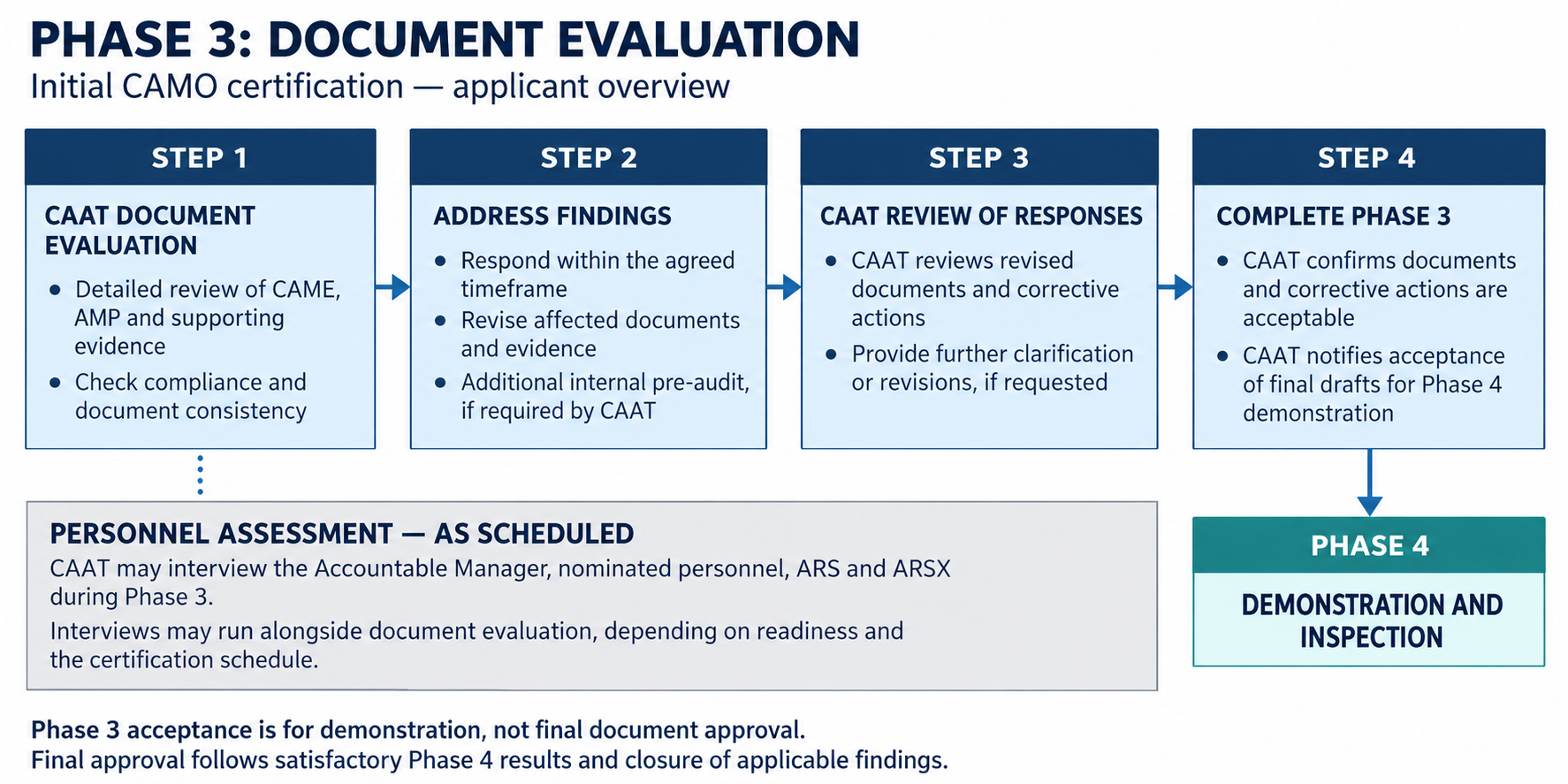
During Phase 3, CAAT will conduct a detailed evaluation of the submitted documents to determine whether the applicant has adequately demonstrated compliance with the applicable Part-CAMO, Part-M, and Part-ML requirements, as applicable.
The documents to be evaluated include, as applicable, the CAME, associated documents, AMP, compliance checklist, Statement of Compliance, Schedule of Events, personnel qualification evidence, maintenance arrangements, subcontracted task arrangements, aircraft entry information, risk assessments, pre-audit results and other supporting documents submitted as part of the formal application package.
The applicant should ensure that all submitted documents are complete, controlled, internally reviewed, and consistent with each other. The documents should clearly show how the applicant intends to comply with the applicable requirements and how the proposed CAMO system will be implemented.
The following tools are used by CAAT to evaluate the documents:
A. Continuing Airworthiness Management Exposition (CAME) and its associated documents (e.g. any separated Reliability Programme Manual, Training Programme Manual, Compliance Monitoring Manual, Safety Management Manual, Standard Operating Procedures, etc.)
B. Part-M Aircraft Maintenance Programmes (M-AMP) and its associated documents (e.g. Reliability Programme Manual, Engine Health Monitoring Programme Manual, etc.)
C. Part-ML Aircraft Maintenance Programmes (ML-AMP)
- Guidance Material for Development of Part-ML Aircraft Maintenance Programmes (ML-AMP)
- CAME 1.2 – Aircraft Maintenance Programme – Development Amendment and Approval
D. CAMO Management and Nominated Personnel (except ARS)
- The completed CAAT résumé form for the Accountable Manager and each nominated person
- Checklist for CAMO Management and Nominated Personnel
- The proposed CAAT Part-CAMO Statement of Compliance
- The completed pre-audit results (for compliance monitoring function nominated personnel)
E. CAMO ARS and ARSX
- The completed CAAT résumé form for each ARS and ARSX
- Checklist for Airworthiness Review Staff (ARS) Assessment
- Checklist for Airworthiness Review Staff Examiner (ARSX) Assessment
F. Pre-audit Results
- § CAMO.A.115(b)
- CAME 0.5.3 – Pre-audit and compliance monitoring statement
- All applicable Compliance Checklists
- The proposed CAAT Part-CAMO Statement of Compliance
NOTE: Where gaps, repeated findings, or significant deficiencies were identified during Phase 3 document evaluation, CAAT may require the applicant to conduct an additional internal pre-audit or focused compliance review before proceeding to the Phase 4 demonstration and inspection.
G. For applications involving aircraft import, delivery, registration, or first aircraft entry, the following will be emphasized for adequate address of procedures:
- CAME 4.4 import / phase-in procedure;
- CAME 0.5.1 aircraft entry change package;
- CAME 1.2 AMP development, applicable generic/baseline AMP conversion, aircraft-specific AMP and bridging process;
- CAME 4.1 to 4.3 airworthiness review process, ARS readiness, draft ARR and final ARR sequence;
- CAME 5.2 ARS list or proposed ARS arrangement;
- CAME 5.4 contracted maintenance arrangement;
- aircraft records, maintenance planning, AD, LLP, component, defect, modification and repair status control;
- aircraft import or phase-in status under M.A.904(e), where applicable
2. Findings and clarification during document evaluation
If CAAT identifies findings, gaps, inconsistencies, or missing information during document evaluation, CAAT may issue findings or request clarification, revision, or additional supporting documents.
Where significant or repeated deficiencies are identified, CAAT may arrange an online or onsite meeting with the applicant to clarify the deficiencies, explain CAAT’s concerns, and support the applicant in understanding the corrective actions required.
The applicant should respond to CAAT findings within the agreed timeframe and should ensure that corrections are properly reflected in the affected documents, procedures, compliance checklist, Statement of Compliance, training records, Schedule of Events, or implementation plan, as applicable.
3. Personnel assessment or interview during Phase 3
During Phase 3, CAAT may conduct interviews or assessments with the Accountable Manager, nominated personnel, ARS, and applicable ARSX to verify their knowledge, qualification, experience, responsibilities, authority, and readiness to perform the assigned CAMO functions.
Where a group of persons is nominated for a CAMO function, CAAT may interview each nominated person according to the responsibilities assigned to that person. For example, the scope of interview may differ between a person responsible for maintenance planning, engineering, technical records, compliance monitoring, safety management, or airworthiness review.
Such interviews may be conducted during Phase 3 to reduce the duration and workload of the onsite CAMO audit during Phase 4, especially where several nominated persons are involved. However, the timing of interviews will depend on the Schedule of Events, personnel readiness, training completion, competency qualification, and the applicant’s proposed certification plan.
For ARS, the demonstration to perform airworthiness review (physical aircraft survey) is required during Phase 4 with actual aircraft.
4. Proceeding to Phase 4
Phase 3 may be completed when CAAT considers that the submitted documents and associated corrective actions are acceptable for the purpose of proceeding to Phase 4 – Demonstration and Inspection.
CAAT will notify the applicant when the final draft expositions, manuals, procedures, and associated documents are ready to be used for demonstration during Phase 4. Such notification does not constitute final approval of the documents.
Final approval of the applicable expositions, manuals, and associated documents will normally be completed after CAAT is satisfied with the Phase 4 demonstration and inspection result, including closure of all applicable findings, and before proceeding to Phase 5 – Certification.
PHASE 4: DEMONSTRATION AND INSPECTION
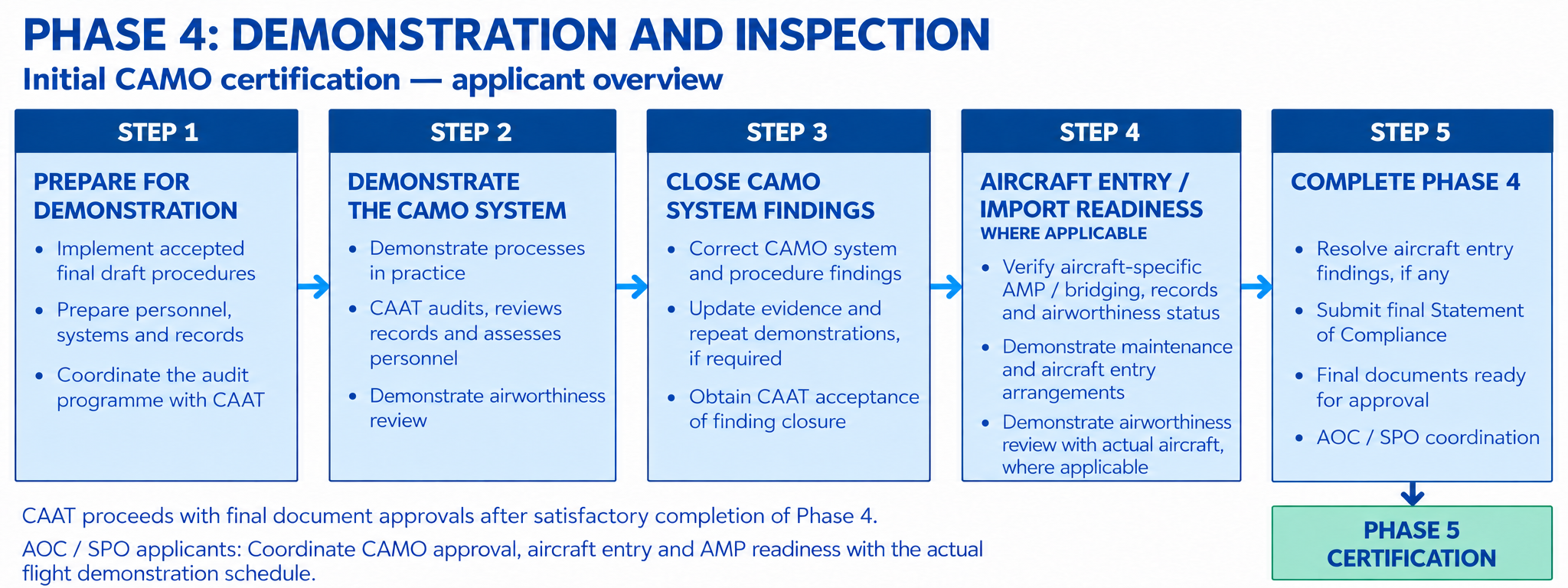
During Phase 4, CAAT will verify whether the applicant can effectively implement the CAMO system described in the final draft CAME, associated documents, manuals, procedures, and supporting arrangements accepted for demonstration at the end of Phase 3.
This phase is intended to confirm that the applicant’s organisation, personnel, facilities, systems, records, maintenance arrangements, subcontracted tasks, AMP control, compliance monitoring system, safety management system, and aircraft entry arrangements, where applicable, are ready to support the requested CAMO approval.
Where the aircraft is intended to be used for AOC or SPO actual flight demonstration, the applicant should plan the CAMO certification timeline to ensure that the relevant CAMO Phase 4 demonstration and inspection activities for the aircraft type or rating concerned are satisfactorily completed before entering the AOC or SPO actual flight demonstration phase. Any findings affecting aircraft entry, AMP control, maintenance planning, records control, AD/MCAI status, defect control, airworthiness review, compliance monitoring, or continuing airworthiness status should be closed or otherwise accepted by CAAT before the aircraft is used for actual flight demonstration.
1. Prepare for Phase 4 Demonstration and Inspection
After completion of Phase 3, the applicant should use the accepted final draft CAME, associated documents, manuals, procedures, and supporting arrangements to prepare for Phase 4.
The applicant should ensure that the CAMO system described in the accepted final draft documents has been communicated, implemented, and is ready to be demonstrated. In particular, the applicant should verify that:
- relevant personnel have been trained on the accepted procedures and understand their responsibilities, authority, reporting lines, interfaces, forms, records, systems, and escalation process;
- the management structure, reporting lines, nominated personnel, and assigned responsibilities are consistent with the accepted final draft CAME;
- the number of personnel, qualifications, experience, competency, licences, and authorisations are adequate for the requested scope, privileges, aircraft ratings, and intended activities;
- facilities, working locations, systems, tools, records, and implementation evidence are available and ready for CAAT verification;
- safety management and compliance monitoring processes are implemented and supported by appropriate records;
- continuing airworthiness management processes are ready to be demonstrated, including AMP control, maintenance planning, AD/MCAI control, defect control, modification and repair status control, technical records, LLP, component status, and reliability programme, where applicable;
- airworthiness review procedures, ARS readiness, and AR-related records are ready, where airworthiness review privilege or ARS authorisation is requested;
- maintenance arrangements are ready to be demonstrated, including the interface between the CAMO and the contracted or approved maintenance organisation;
- subcontracted continuing airworthiness management task arrangements are ready to be demonstrated, including liaison between the CAMO, subcontracted organisation, and contracted maintenance organisation, where applicable;
- CAME, associated documents, forms, controlled lists, contracts, arrangements, and records are available and reflect actual implementation;
- any aircraft entry, import, or phase-in package is ready, where applicable;
- the Schedule of Events remains accurate and is revised where necessary.
Where significant gaps, repeated findings, or systemic deficiencies were identified during Phase 3 document evaluation, CAAT may require the applicant to conduct an additional internal pre-audit or focused compliance review before proceeding to Phase 4. The additional review should focus on the affected areas and verify that the revised procedures, corrective actions, training, records, arrangements, and implementation evidence are adequate before CAAT conducts the demonstration and inspection.
CAAT will coordinate the audit date, audit scope, method, agenda, and notification with the applicant. The applicant should ensure that the Accountable Manager, nominated personnel, ARS, relevant staff, and other required persons are available according to the audit programme.
2. Participate in CAAT Demonstration and Inspection
During the demonstration and inspection, the applicant should be prepared to demonstrate how the CAMO system works in practice.
CAAT will conduct CAMO audit, remote demonstration, personnel interview, system demonstration, record sampling, aircraft-related demonstration, ARS performance assessment, and review of implementation evidence.
The applicant should be able to demonstrate, as applicable:
- management structure and reporting lines;
- adequacy of personnel, qualification, experience, competency, and authorisation;
- safety management and compliance monitoring processes;
- continuing airworthiness management processes;
- airworthiness review process;
- facilities and working locations, including subcontracted facilities;
- maintenance arrangements and CAMO-AMO coordination;
- subcontracted continuing airworthiness management task control;
- AMP development, amendment, and control;
- maintenance planning, technical records, AD/MCAI, defect, modification, repair, LLP, and component control;
- ability to manage continuing airworthiness for each aircraft type requested;
- effective implementation of the accepted CAME and associated documents.
Where the interview or assessment of the Accountable Manager, nominated personnel, nominated groups of persons, ARS, or ARSX has not been completed during Phase 3, CAAT may conduct the interview or assessment during Phase 4.
The following tools are used by CAAT to evaluate the CAMO performance:
A. CAMO Audit
B. CAMO Management and Nominated Personnel (except ARS)
- Checklist for CAMO Management and Nominated Personnel
- The proposed CAAT Part-CAMO Statement of Compliance
- The completed pre-audit results (for compliance monitoring function nominated personnel)
3. Correct Findings, Update Evidence, and Repeat Demonstration Where Required
Where findings are raised during Phase 4, the applicant should correct the deficiencies and provide evidence of corrective action within the agreed timeframe.
Corrective action may include:
- revising CAME or associated documents;
- updating forms, records, checklists, or controlled lists;
- correcting system data or aircraft records;
- revising maintenance arrangements or subcontracted task arrangements;
- conducting additional training;
- repeating affected demonstrations;
- updating risk assessments or mitigation actions;
- submitting updated Statement of Compliance or compliance checklist, where affected.
Where Phase 4 findings affect the accepted exposition, the applicant may submit an acceptable revised draft procedure for finding closure. However, the affected exposition will remain in draft status until CAAT is satisfied that all applicable findings have been closed.
If significant organisational, procedural, or scope changes occur after completion of Phase 3, CAAT may require re-evaluation using the applicable CAME or AMP compliance checklist before final approval. This may also require associated demonstration and inspection.
4. Aircraft Entry / Import Readiness Demonstration, where applicable
Where aircraft import, delivery, registration, first aircraft entry, or aircraft phase-in is involved, the applicant should demonstrate that its continuing airworthiness management system is ready to manage the aircraft concerned.
Before proceeding with the aircraft entry or import readiness demonstration, the applicant should have satisfactorily demonstrated the CAMO system and obtained CAAT acceptance of the closure of all findings affecting the continuing airworthiness management system and its associated procedures.
Available data and records of the aircraft intended to be introduced may be used during the preceding Phase 4 activities to demonstrate the CAMO system. This allows the applicant to demonstrate its processes using the intended aircraft configuration and maintenance information before proceeding with aircraft entry.
The aircraft entry or import readiness demonstration should cover, as applicable:
- application of the accepted CAME procedures and proposed scope of approval to the aircraft concerned;
- aircraft-specific AMP development and control, including conversion of a generic or baseline AMP, bridging assessment, and the applicable reliability programme;
- maintenance planning and readiness of the maintenance arrangements;
- aircraft records and continuing airworthiness status control, including AD, modification, repair, LLP, component, defect, and MEL status;
- access to applicable maintenance data and continuing airworthiness data;
- implementation of the airworthiness review process, ARS readiness, and arrangements for the aircraft physical survey;
- aircraft entry, import, or phase-in arrangements, including the assignment of continuing airworthiness responsibility; and
- application of compliance monitoring, risk assessment, and mitigation actions to the aircraft entry.
The applicant should be aware that aircraft entry, import inspection, C of R, C of A, or aircraft delivery may be delayed if significant deficiencies are identified during Phase 4. Some findings may require re-assessment or re-demonstration and may not be closed by documentary correction alone.
READINESS BEFORE CAAT AIRCRAFT INSPECTION
Before requesting CAAT inspection in connection with the issuance of the Certificate of Registration or Certificate of Airworthiness, the applicant should have completed the continuing airworthiness management system demonstration and resolved all related findings, including those identified during the aircraft entry or import readiness assessment, to CAAT’s satisfaction.
At that stage, any remaining CAMO certification demonstration should be limited to the airworthiness review elements that require the actual aircraft. This may include the ARS physical survey performance assessment where the aircraft is the first actual aircraft available for demonstration under the relevant aircraft rating. Such demonstration may be coordinated with the CAAT aircraft inspection, provided that the relevant procedures, personnel preparation, and supporting records are already in place.
TIMING FOR COMPLEX MOTOR-POWERED AIRCRAFT (CMPA)
For CMPA, the aircraft must be under the continuing airworthiness management of an appropriately approved CAMO from the time of registration in Thailand. The certification, aircraft inspection, and registration schedules should therefore ensure that, as a minimum, the relevant CAMO Phase 4 activities have been satisfactorily completed before registration. This includes closure of applicable findings and completion and CAAT acceptance of any outstanding aircraft-dependent airworthiness review demonstration.
The CAMO assuming responsibility for the aircraft from registration must hold the applicable CAMO approval and aircraft rating.
Any findings arising from the aircraft entry or airworthiness review demonstration should be resolved to CAAT’s satisfaction before Phase 4 is completed. Re-assessment or repeat demonstration may be required; documentary correction alone may not be sufficient. Unresolved findings may delay aircraft entry, registration, Certificate of Airworthiness issuance, or completion of CAMO certification.
5. Complete Phase 4 before Certification
Phase 4 will be completed when CAAT is satisfied that:
- all Phase 4 findings have been closed or otherwise accepted;
- any finding affecting procedural exposition has been corrected;
- audit reports and relevant evidence have been completed;
- accepted expositions affected by findings have been updated;
- final draft expositions are ready for approval;
- the final updated Statement of Compliance has been submitted;
- aircraft entry issues affecting certification have been resolved, where applicable.
After Phase 4 is satisfactorily completed, CAAT will proceed with approval of the applicable expositions and associated documents before proceeding to Phase 5 – Certification.
6. Coordination with AOC / SPO actual flight demonstration
Where the aircraft is intended to be used for AOC or SPO actual flight demonstration, the applicant should plan the CAMO certification timeline carefully to ensure that the relevant CAMO demonstration and inspection activities are satisfactorily completed before entering the actual flight demonstration phase of the AOC or SPO certification process.
For aircraft required to be managed by a CAMO under Part-M, the aircraft should not be used for AOC / SPO actual flight demonstration unless CAAT is satisfied that the CAMO has demonstrated its ability to manage the continuing airworthiness of the aircraft type or rating concerned.
This means that, before the aircraft proceeds to AOC / SPO actual flight demonstration, the applicant should ensure that, as applicable:
- Phase 4 CAMO demonstration and inspection for the relevant aircraft type or rating has been satisfactorily completed;
- any findings affecting aircraft entry, AMP control, maintenance planning, records control, AD/MCAI status control, defect control, airworthiness review, compliance monitoring, or aircraft continuing airworthiness status have been closed or otherwise accepted by CAAT;
- the aircraft-specific AMP or applicable bridging arrangement is ready for approval or acceptance;
- the aircraft entry / import readiness demonstration has been satisfactorily completed, where applicable;
- the aircraft is ready to be accepted into the CAMO continuing airworthiness management system;
- the relevant CAMO approval, variation, aircraft rating, aircraft entry, AMP, and operational approval timelines are properly coordinated with CAAT.
The applicant should reflect this coordination in the Schedule of Events. Where the AOC / SPO actual flight demonstration date changes, or where CAMO Phase 4 findings affect aircraft readiness, the applicant should revise the Schedule of Events and coordinate the impact with CAAT.
PHASE 5: CERTIFICATION
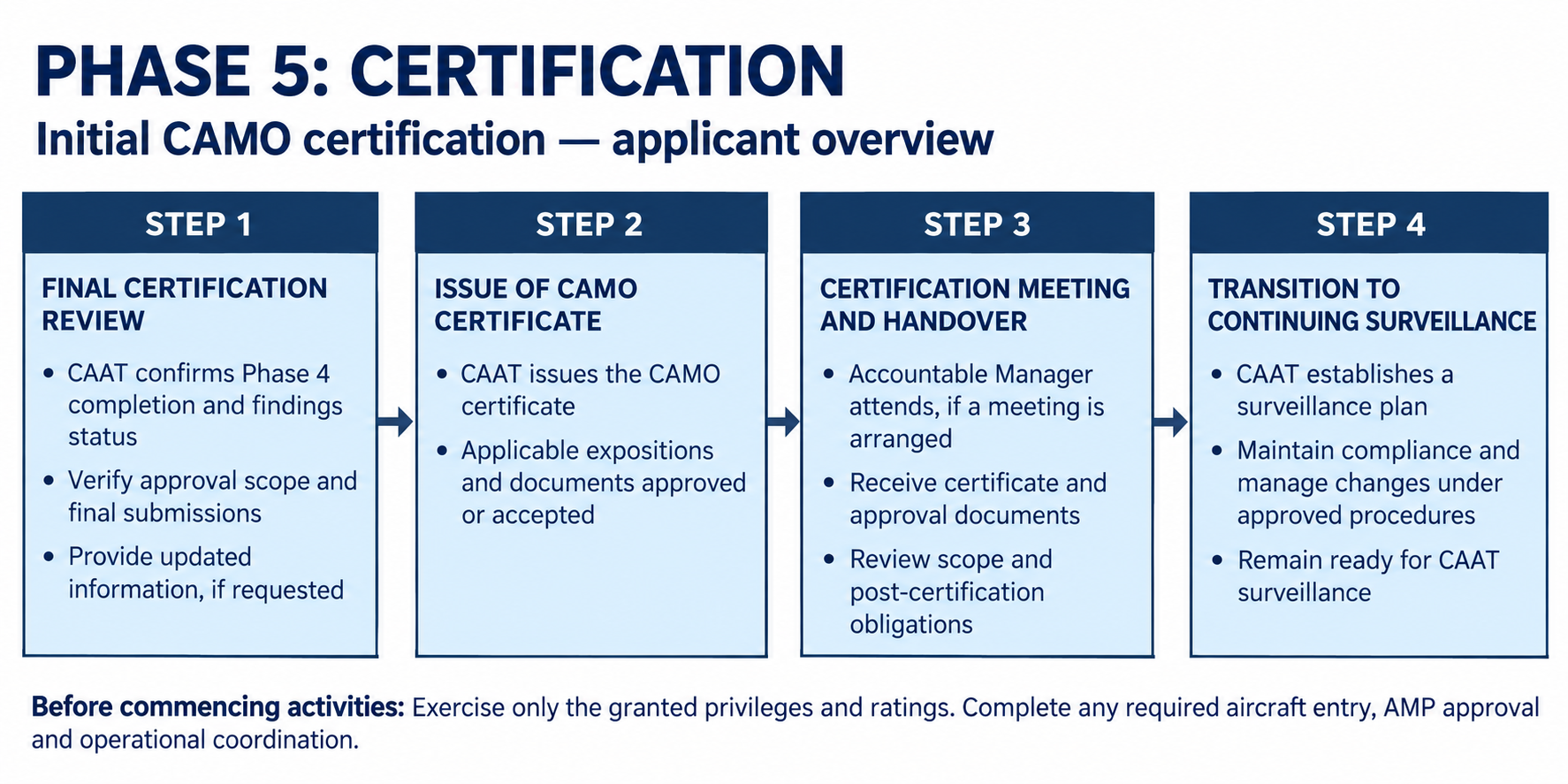
During Phase 5, CAAT will complete the final certification process after Phase 4 has been satisfactorily completed. This phase includes final review of the certification package, approval of applicable expositions and associated documents, issuance of the CAMO certificate, and handover of the certificate and relevant approval documents to the applicant.
Before the CAMO certificate is issued, CAAT will ensure that all applicable findings have been closed or otherwise accepted, the final Statement of Compliance has been updated, the applicable expositions and associated documents are ready for approval, and the requested scope, privileges, limitations, ratings, facilities, personnel, and related arrangements are properly reflected in the certification package.
1. Final Certification Review
After Phase 4 has been satisfactorily completed, CAAT will conduct a final review to confirm that the certification process is complete and that the requested CAMO approval may be granted.
This review is intended to confirm that all applicable findings have been closed or otherwise accepted, the approved scope is correctly defined, the applicable expositions and associated documents are ready for approval, and the CAMO certificate can be issued.
The applicant may be requested to confirm or provide final information where necessary, such as updated contact details, final Statement of Compliance, final Schedule of Events, approved exposition and all associated documents, aircraft rating information, personnel information, facility information, or aircraft entry information where applicable.
2. Issue of CAMO Certificate and Approved Documents
Once the certification package has been approved, CAAT will issue the CAMO certificate and approve or accept the applicable expositions and associated documents, as applicable.
The applicant should only exercise the CAMO privileges, ratings, and functions granted in the CAMO certificate and approved scope. Any condition, limitation, aircraft rating, facility, subcontracted arrangement, airworthiness review privilege, or associated document forming part of the approval should be complied with by the CAMO.
The applicant should not commence CAMO activities beyond the approved scope or before completion of any required aircraft entry, AMP approval, aircraft-specific control, or related operational coordination.
3. Certification Meeting and Handover
CAAT may arrange a certification meeting with the applicant’s Accountable Manager and relevant management team.
The meeting is intended to:
- review the overall certification result;
- confirm the approved CAMO scope, privileges, ratings, limitations, and conditions;
- provide the CAMO certificate and related approval documents;
- explain post-certification obligations and continuing surveillance;
- confirm any remaining coordination items, including aircraft entry or operational interface, where applicable.
The Accountable Manager should attend this meeting. A representative should not replace the Accountable Manager unless otherwise accepted by CAAT.
4. Transition to Continuing Surveillance
After the CAMO certificate has been issued, the CAMO will be subject to continuing CAAT surveillance. CAAT will establish a surveillance plan based on the approved scope, complexity, aircraft types, privileges, certification result, findings history, and risk profile.
The CAMO should maintain continued compliance with the applicable requirements, approved CAME, associated documents, approved AMP, approved privileges, and any conditions or limitations stated in the CAMO certificate. Any change after certification should be managed in accordance with the approved change procedure and applicable CAAT requirements.
The issue of the CAMO certificate confirms that CAAT has completed the initial certification process for the approved scope. It does not remove the CAMO’s continuing responsibility to comply with applicable requirements, maintain effective management system performance, manage changes properly, and remain ready for CAAT surveillance.
CHANGES TO THE CAMO
1. Changes during the CAMO approval process
During the CAMO approval process, the applicant should inform CAAT as soon as possible of any change that may affect the application, the proposed CAMO organisation, the requested scope of approval, the submitted documents, or the agreed Schedule of Events.
Changes during the approval process may affect CAAT’s evaluation, demonstration and inspection plan, certification timeline, or the applicant’s readiness to proceed to the next phase. The applicant should not assume that a change can be incorporated without further CAAT assessment.
Such changes may include, but are not limited to:
- change of company name, address, principal place of business, facilities, or working locations;
- change of Accountable Manager, nominated personnel, ARS, ARS Examiner, or key personnel;
- change of management structure, reporting lines, responsibilities, or interfaces;
- change of requested scope, privileges, limitations, aircraft ratings, or aircraft types;
- change of aircraft to be managed, aircraft entry plan, aircraft import or phase-in plan;
- change of AMP, generic or baseline AMP conversion, or aircraft-specific AMP;
- change of contracted maintenance arrangement;
- change of subcontracted continuing airworthiness management tasks;
- change of compliance monitoring system, safety management system, audit programme, or audit methodology;
- change of CAME, associated documents, procedures, forms, controlled lists, contracts, or arrangements;
- change of certification timeline or Schedule of Events.
Where a change occurs before completion of Phase 3, CAAT may require the applicant to update the affected documents, Statement of Compliance, Schedule of Events, pre-audit result, or supporting evidence before the document evaluation can be completed. The OP specifically identifies several Phase 3 changes that may require additional pre-audit coverage, including changes to reporting lines, departments affecting continuing airworthiness, aircraft types, privileges, contracted maintenance arrangements, subcontracted tasks, CAM control processes, responsibility allocation, external interfaces, or new procedures introduced through corrective action.
Where a change occurs after completion of Phase 3, and the change may affect compliance with Part-CAMO or the integrity of the management system described in the accepted final draft CAME, CAAT may require re-evaluation using the applicable CAME or AMP compliance checklist before final approval. This may also require additional demonstration, inspection, reassessment, or re-audit, as applicable.
Examples of changes after Phase 3 that may require further CAAT assessment include:
- change affecting the scope of approval, such as addition or removal of aircraft type, change in fleet composition, transition between AOC CAMO and non-AOC CAMO, or change in maintenance contracting concept;
- replacement of Accountable Manager or key nominated personnel, major restructuring of the organisation, change to compliance monitoring or safety management structure, or relocation affecting records control or oversight;
- introduction of new procedures or systems affecting compliance demonstration, such as reliability programme, AMP escalation, new contracted/subcontracted arrangements, or digital records system;
- discovery during Phase 4 that the actual practice significantly differs from the accepted CAME procedures, or that previously accepted procedures are incomplete, misunderstood, or non-compliant.
Where the change affects an exposition, manual, AMP, procedure, contract, arrangement, or Statement of Compliance, the applicant should submit the revised document and clearly identify the affected parts. CAAT may require the revised document to be re-evaluated, re-accepted as a final draft for demonstration, or approved only after satisfactory completion of any required demonstration or finding closure.
The applicant should also update the Schedule of Events where the change affects the certification timeline, readiness for Phase 4 demonstration and inspection, aircraft entry, import, phase-in, AOC/SPO coordination, or planned date for actual flight demonstration.
Changes during the CAMO approval process should be controlled, declared, assessed, and reflected in the submitted documents before CAAT proceeds to the next certification step. The later the change occurs in the process, especially after Phase 3, the more likely it is that CAAT may require additional document evaluation, pre-audit, demonstration, inspection, or reassessment before certification can be completed.
2. Changes to the approved CAMO approval
After the CAMO certificate has been issued, the CAMO is responsible for ensuring that any change affecting its approval, organisation, management system, scope of work, privileges, limitations, aircraft ratings, facilities, personnel, procedures, associated documents, contracted arrangements, subcontracted continuing airworthiness management tasks, or aircraft under management is properly assessed, controlled, and managed in accordance with the approved CAME and applicable CAAT requirements.
Changes to an approved CAMO are generally managed through one of the following processes:
a. Variation of CAMO Certificate – Changes requiring prior approval
This process applies to changes that require CAAT approval before implementation. The CAMO shall not implement such changes until approval has been granted by CAAT, unless otherwise accepted by CAAT in exceptional or unavoidable circumstances with appropriate risk mitigation.
b. CAMO Notification to CAAT – Changes not requiring prior approval
This process applies to changes that must be managed by the CAMO under its approved procedure for changes not requiring prior approval in accordance with § CAMO.A.130(c), where such privilege and procedure have been approved by CAAT. The CAMO shall notify CAAT in accordance with the approved CAME procedure and the applicable CAAT notification process.
The CAMO should assess each proposed change to determine whether it requires prior approval or may be managed through notification. Where the CAMO is uncertain whether a change requires prior approval, the CAMO should consult CAAT before implementing the change.
Changes requiring prior approval includes, but are not limited to, changes affecting:
- organisation name, principal place of business, main CAMO activity facility, or approved CAMO site;
- Accountable Manager, nominated personnel, ARS, ARS Examiner, or manpower that affects the approved scope or privileges;
- management structure, reporting lines, responsibilities, or communication lines required under the approved CAME;
- scope of approval, privileges, limitations, aircraft ratings, aircraft type/series/group, engine model, or first aircraft registration under a rating previously granted on a generic or baseline AMP basis;
- addition, removal, or change of subcontracted organisation or subcontracted continuing airworthiness management task arrangement affecting the scope of work;
- contracted maintenance arrangement or list of contracted approved maintenance organisations where the change affects the scope of work, maintenance control capability, or continuing airworthiness management responsibility;
- IT system or records system affecting continuing airworthiness management activities or approved privileges;
- procedures required for changes not requiring prior approval, AltMoC, reporting lines, ARS supervision, personnel competency control, indirect AMP approval, or other procedures affecting the approved scope or privileges;
- aircraft entry, import, delivery, registration, or addition/removal of aircraft registration where CAAT approval is required by the applicable procedure.
Not every editorial or administrative amendment is necessarily treated in the same way. Minor amendments, associated documents, AMP amendments, contracted maintenance lists, or contract changes that do not affect the approval may be managed through the approved notification process where the CAMO has been granted the relevant privilege and the approved CAME procedure allows it. Where the CAMO has not been granted the privilege to manage changes not requiring prior approval, all changes shall be submitted to CAAT for approval before implementation.
SURVEILLANCE OF THE CAMO CERTIFICATE HOLDER
After the CAMO certificate has been issued, the CAMO certificate holder will be subject to continuing surveillance by CAAT to verify continued compliance with the applicable requirements, the approved CAME, approved privileges, ratings, limitations, procedures, and associated documents.
CAAT will establish an initial surveillance plan for the newly certificated CAMO. The first surveillance activity will normally be conducted within 6 months after initial certification to verify continued compliance and effective implementation of the CAMO system after approval. The surveillance interval may be adjusted by CAAT based on the CAMO’s certification performance, risk profile, complexity of activities, aircraft types, privileges granted, findings history, and operational readiness.
Where justified by documented circumstances, such as aircraft inactivity, resource limitations, stable performance, or previous experience under the former regulatory framework with a medium to low risk profile, CAAT may extend the first surveillance interval up to 12 months. Conversely, where the initial certification process indicates poor performance, failure to meet the committed Schedule of Events, significant implementation weaknesses, or serious findings during Phase 4, CAAT may conduct surveillance earlier than 6 months.
The CAMO certificate holder should remain ready to demonstrate continued compliance at all times. This includes maintaining effective implementation of the approved CAME, management system, compliance monitoring system, safety management system, continuing airworthiness management processes, airworthiness review procedures, maintenance arrangements, subcontracted task controls, AMP control, records, personnel competency, and any approved privileges or limitations.
Further information on CAAT’s continuing oversight methodology, surveillance planning, surveillance cycle, inspection scope, and risk-based surveillance programme will be provided separately under the Surveillance Programme of CAMO Certificate Holders.
FAQs
Frequently asked questions relating to CAMO initial certification, application preparation, document submission, aircraft entry, AMP approval, maintenance arrangements, subcontracted continuing airworthiness management tasks, airworthiness review privilege, and other related topics are provided on the CAMO Frequently Asked Questions (FAQ) page.
Applicants are encouraged to review the FAQ page before submitting an application or contacting CAAT, as it may provide practical clarification on common issues encountered during the CAMO certification process.
For further details, please refer to CAMO Frequently Asked Questions (FAQ).
REGULATION / GUIDANCE MATERIAL / FORMS AND CHECKLISTS
For further details, please refer to Regulation / Guidance material / Forms and Checklist.