

การขอรับรองแผนการฝึกอบรมหลักสูตรเกี่ยวกับวัตถุอันตราย
What is Competency-based training and assessment ?
Competency-based training and assessment means “Training and assessment that are characterized by a performance orientation, emphasis on standards of performance and their measurement, and the development of training to the specified performance standards.”
The goal of competency-based training and assessment is to produce a competent workforce by providing focused training. It does so by identifying key competencies that need to be achieved, determining the most effective way of achieving them and establishing valid and reliable assessment tools to evaluate their achievement.
Overview
The dangerous goods training framework for Thailand and the corresponding application forms for Approval of Dangerous Goods Training Programmes are designed to align to the aforementioned requirements. Organizers need to ensure that DG training provided to personnel on or after 1 January 2023 meets the new requirements. Training certificates that are issued before 1 January 2023 and have a validity period beyond 1 January 2023 will continue to be valid until they expire.
The ensuing paragraphs contain information to assist applicants in adopting a competency-based approach to DG training and assessment (CBTA) in their DG training programme intended for consideration and approval by the CAAT.
CAAT had established Guidance Material for Competency-based approach to dangerous goods training and assessment which is adapted from the ICAO Document – Guidance on a Competency-based Approach to Dangerous Goods Training and Assessment (ICAO Doc 10147) and can be read in conjunction with the Proposed Framework for Implementation of Competency-based Approach to Dangerous Goods Training and Assessment in Thailand.
This guidance will go into the details of the preparation, design and development of CBTA and will involve technical details relevant to the training provisions set out in the ICAO TI. It is therefore intended to be read by qualified DG training instructors who will establish and maintain a DG training programme by themselves or on behalf of their organizers.
Note: As of July 1, 2023, the organization are required by CAAT to fully implement Competency-Based Training and Assessment for Dangerous Goods Training.
During the transition period (1 January 2023 – 30 June 2023), the operator may use the Dangerous Goods Training Programme in Category(ies) until end of June 2023.
Application of Approval for Dangerous Goods Training Programme in Category(ies) Click here!!
Regulations and Requirements
- Annex 18 — The Safe Transport of Dangerous Goods by Air
- Technical Instructions for the Safe Transport of Dangerous Goods by Air (Technical Instructions) (Doc 9284)
- International Civil Aviation Organization – Guidance on a Competency-based Approach to Dangerous Goods Training and Assessment (Doc 10147)
- International Air Transport Association (IATA) – Dangerous Goods Regulations
- International Air Transport Association (IATA) – Dangerous Goods Training Guidance for Competency-based Training and Assessment Approach
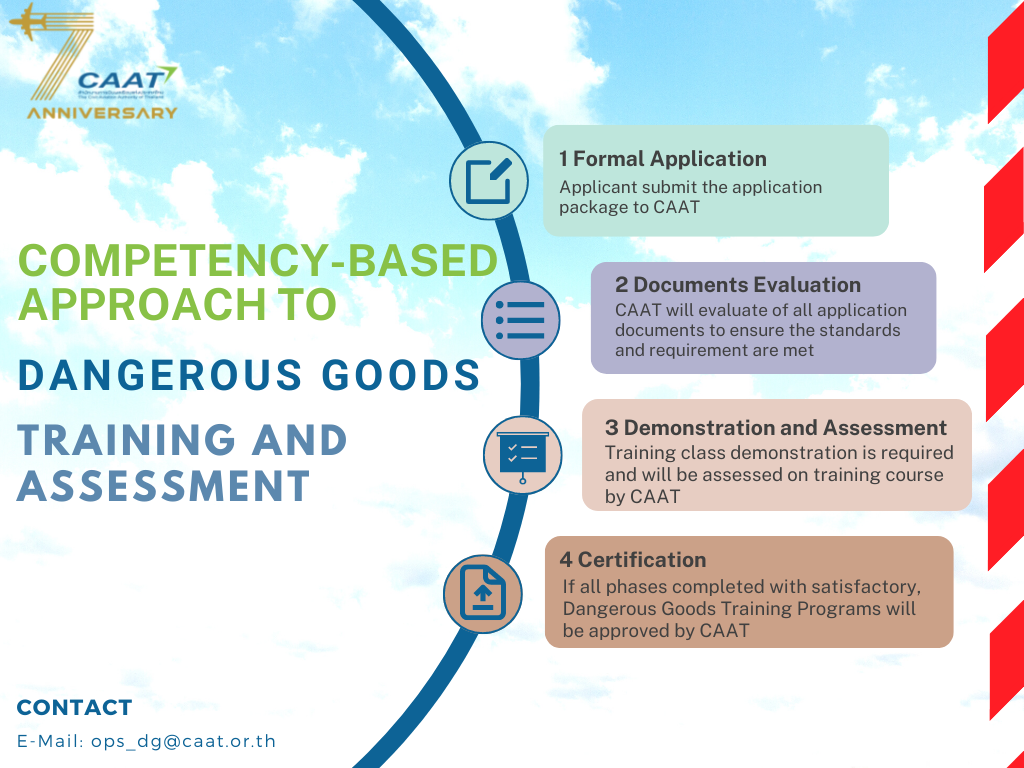
Approval Process consists of 4 phases and will normally take following sequence;
Phase 1 – Formal Application
The applicant shall prepare following documents and the application package shall be submitted at the CAAT office, 11th floor.
- Intention letter on the applicant’s company letterhead specifying the title of the training programme and the job function of the personnel involved
- CAAT-OPS-TDGFM-401 Application for Approval of Dangerous Goods Training Programs
- OPS-TCDGI-302 OPS-Approval of Dangerous Goods Training Programs
- OPS-TCDGI-303 OPS- Approval of Dangerous Goods Training Programs_ Postal
- the list of tasks, and for each task make reference to the corresponding parts of training and assessment materials (refer DGCBT Table 1 of Appendix A – Adapted DG task list by well-defined roles)
- the DG Knowledge table (refer DGCBT Table 2 of Appendix B – Adapted DG Knowledge table)
- an example of an adapted competency model (refer DGCBT Appendix C – Example of an adapted competency model), this item can be combined into Template summary of design output for personnel responsible for specific functions (refer DGCBT Appendix D – Sample Form Summary)
- a sample certificate, if any (refer DGCBT Appendix E – Sample certificate template)
- the Training Needs Analysis Form for Shipper and Freight Forwarder (refer DGCBT Appendix F – Training Need Analysis Form for Shipper and Freight Forwarder)
- the Training Needs Analysis Form for Operator and Ground Handling Agent for air operators and related agencies (refer DGCBT appendix G – Training Need Analysis Form for Operator and Ground Handling Agent)
- training course outline (e.g., delivery format, tool to be used, assessment methods and duration)
- the training materials
- the assessment materials with answers where applicable
- the qualifications and experiences of the instructors (refer DGCBT Chapter 3)
- the course evaluation or feedback form
- Training Year Plan for Dangerous Goods Training
- Photos of training facility and equipment
- Other documents required by competent official, if any
The application package of approval for dangerous goods training programme shall be completed and submitted to CAAT 60 Days before the date of scheduled class.
Phase 2 – Document Evaluation
A thorough evaluation of all application documents including training/testing materials and attachments etc. This is to ensure that the standards and requirements for dangerous goods training programmes had been met.
Phase 3 – Demonstration and Assessment of the Training
Applicants for DG training programme approval will be required to demonstrate that their designed dangerous goods training programme have been performed effectively and based on the principles of competency-based approach to training and assessment. This phase will require demonstration for dangerous goods training by applicant and CAAT will perform assessment on training course and instructor.
Phase 4 – Certification
After all the demonstrations and assessments (including review of documentation), have been completed with satisfactory. Eventually, the dangerous goods training programme will be approved by CAAT.
Guidance Material
| No. | Code | Name | Revision | Date | Link |
|---|---|---|---|---|---|
| 1 | CAAT-GM-OPS-DGCBT | Guidance Material for Competency-based approach to dangerous goods training and assessment | 01 | 26 Dec 23 | Download |
| 2 | N/A | CAAT Presentation of Dangerous Goods Training Programme CBTA Concept for AOC Workshop | N/A | 1 Jun 23 | Download |
Application and Checklist
| No. | Code | Name | Link |
| 1 | CAAT-OPS-TDGFM-401 | Application for Approval of Dangerous Goods Training Programs | Download |
| 2 | OPS-TCDGI-302 | OPS-Approval of Dangerous Goods Training Programs | Download |
| 3 | OPS-TCDGI-303 | OPS- Approval of Dangerous Goods Training Programs_ Postal | Download |
| 4 | CAAT-OPS-DG-406 | Proposal of Dangerous Goods Training Program Amendment Form | Download |
| 5 | OPS-TCDGI-304 | OPS-Dangerous Goods Training Evaluation | Download |
Contact us
If you have further questions, ask our team at Flight Operations Standards Departments, Dangerous Goods Standards Division
222 Soi Vibhavadi Rangsit 28, Vibhavadi Rangsit Road, Chatuchak, Chatuchak, Bangkok, Thailand 10900
TEL: 02-568-8800 ext.8843 or 0612
Mobile: 063-2058838 (Mon-Fri, 08:30-16:30 LT)
E-mail: [email protected]